Understanding Layer 1 Blockchain: A Comprehensive Guide
What are Layer 1 Blockchains?
Decentralization stands as the cornerstone of virtual currencies like Bitcoin (BTC), yet this absence of centralized control doesn't translate to disorder. Rather, the cryptocurrency ecosystem demonstrates remarkable intricacy and sophisticated organization in its technical architecture. The foundation of this organized chaos lies in the robust, self-sufficient protocols that enable secure peer-to-peer transfers. For many cryptocurrency projects, the layer 1 blockchain serves as the fundamental infrastructure of their software design, making it an essential starting point for understanding this revolutionary technology.
What is a Layer 1?
Layer 1 (L1) blockchains represent decentralized software protocols that form the backbone of numerous cryptocurrencies. Understanding what is Layer 1 is crucial for anyone entering the crypto space—these L1s function simultaneously as rule-makers and enforcers within crypto projects. The underlying code of an L1 protocol establishes the standards that computers, known as nodes, must adhere to for securely broadcasting, verifying, and publishing new transactions on the public payment ledger. This coding framework encompasses all operational instructions for how a cryptocurrency functions.
Positioned at the "ground floor" of a cryptocurrency's architecture, L1 blockchains are frequently characterized as the foundation or base layer. When exploring what is Layer 1, it's important to note that developers often use the term "mainnet" interchangeably with L1, as the L1 protocol contains all essential details necessary for a cryptocurrency's operation. This foundational nature makes L1 blockchains the primary layer upon which all other components of a crypto ecosystem are built.
How do Layer 1 Blockchains Work in Crypto?
While each cryptocurrency employs unique coding standards and protocols to operate its network, L1 blockchains universally require a consensus mechanism to establish trust among decentralized node operators. To fully understand what is Layer 1, one must grasp that these consensus mechanisms utilize algorithms to set and enforce rules for properly processing cryptocurrency payments.
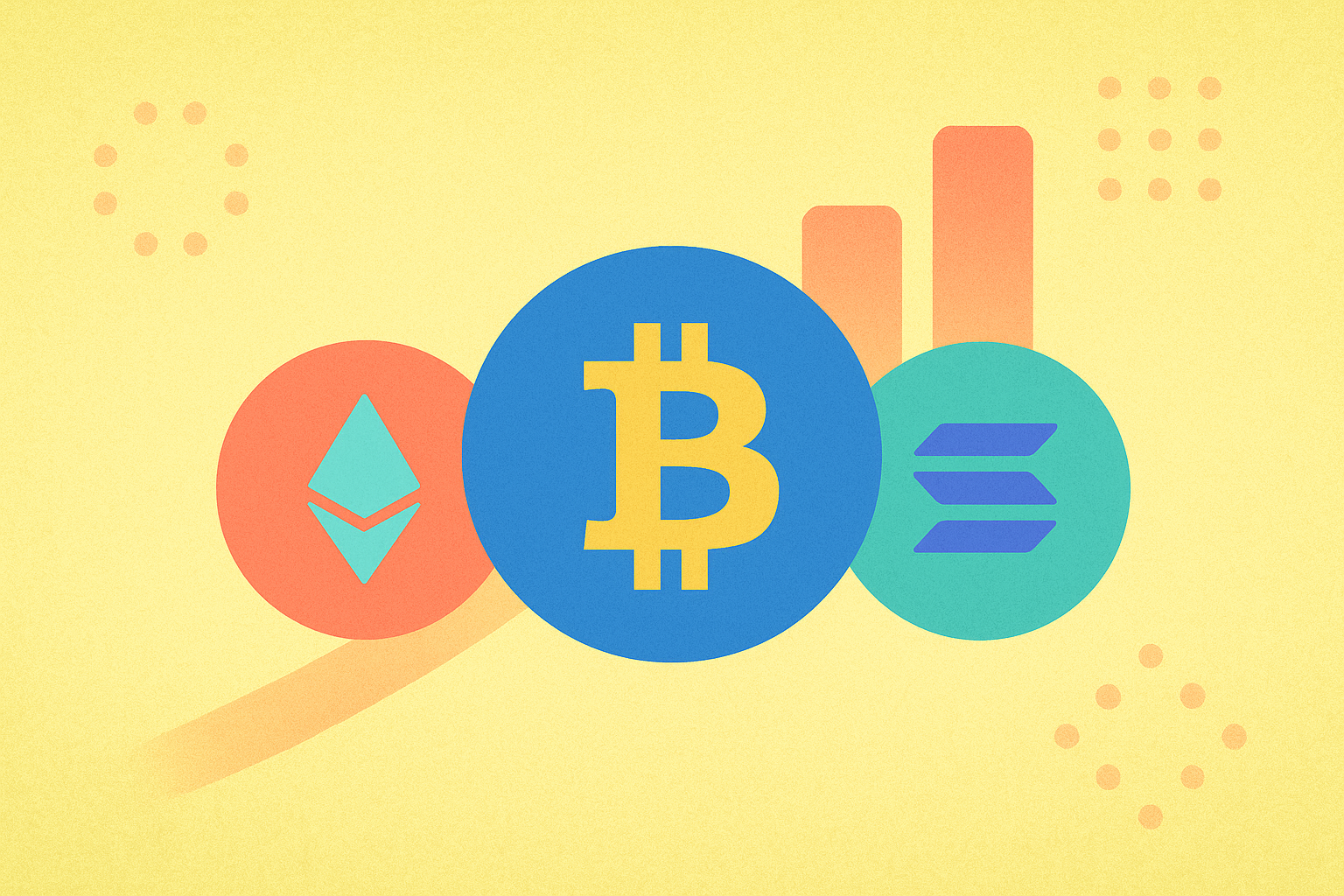
For instance, the Bitcoin blockchain implements a proof-of-work (PoW) consensus model, where computers compete to solve complex algebraic equations every 10 minutes to post new BTC transfers on the payment ledger. Conversely, L1 blockchains like Ethereum (ETH) and Solana (SOL) employ a proof-of-stake (PoS) consensus mechanism, where nodes lock cryptocurrency on the blockchain to earn the opportunity to validate transactions.
To incentivize node operators on these L1 protocols, both PoW and PoS networks reward nodes that successfully publish blocks with the native cryptocurrency. Bitcoin nodes receive BTC rewards, while Ethereum nodes receive ETH as compensation for their validation services.
Beyond the consensus algorithm, L1 blockchains incorporate additional security procedures in their code to promote process integrity and deter malicious actors. Many PoS blockchains implement "slashing" policies, which confiscate staked cryptocurrency from node operators who misbehave or fail to fulfill their duties. Bitcoin employs a different approach, requiring node operators to wait for six separate confirmations to ensure BTC transfer validity before posting them on the final payment ledger.
L1 blockchains also manage transaction fees (commonly referred to as gas fees) and the issuance schedule for a blockchain's native cryptocurrency. Bitcoin's L1 blockchain automatically reduces the amount of BTC entering circulation every four years during an event called "the halving." In contrast, Ethereum's L1 features a dynamic ETH issuance and "burning" mechanism, whereby the blockchain automatically adds and subtracts ETH from circulation based on network activity. The Ethereum network burns a portion of every user fee paid on the blockchain to manage ETH's inflation rate.
Examples of Layer 1 Blockchains
Bitcoin introduced the framework for a successful L1 blockchain, and hundreds of subsequent cryptocurrencies have followed BTC's lead with their own L1 chains. Understanding what is Layer 1 becomes clearer when examining real-world examples. Today's most widely used cryptocurrencies rely on L1 blockchains to secure their networks.
Bitcoin stands as the oldest and largest cryptocurrency, launched by the pseudonymous cryptographer Satoshi Nakamoto. BTC's L1 blockchain utilizes an energy-intensive PoW consensus algorithm where nodes compete every 10 minutes to solve mathematical problems and post new transactions.
Ethereum ranks second to Bitcoin in market capitalization and represents a crypto project that enables third-party developers to create decentralized applications (dApps) on top of its L1 protocol. When exploring what is Layer 1, Ethereum serves as an excellent example—originally launched as a PoW L1 blockchain modeled on Bitcoin's consensus algorithm, it has since transitioned to a PoS consensus mechanism through "The Merge" upgrade.
Litecoin (LTC) was created as a cryptocurrency designed for fast and inexpensive peer-to-peer virtual currency transactions. Although Litecoin uses a different algorithm in its L1 design, it maintains a PoW consensus mechanism similar to the Bitcoin Network.
Solana belongs to the category of "Ethereum competitors," blockchains that offer similar services to Ethereum with distinctive traits such as faster confirmation speeds or lower transaction fees. Solana's PoS L1 is particularly renowned for its high transaction throughput, potentially reaching 50,000 transactions per second (TPS).
Cardano represents another PoS L1 blockchain in the Ethereum competitor category. Founded by former Ethereum developer Charles Hoskinson, the Cardano blockchain emphasizes peer-reviewed technological research and welcomes third-party developers to build dApps on its L1 blockchain.
What are Some Limitations of Layer 1 Protocols?
Despite their importance in processing safe and efficient crypto transactions, L1 blockchains often lack flexibility. When considering what is Layer 1, it's essential to acknowledge both strengths and limitations. The algorithms on L1 blockchains are deliberately deterministic to ensure all participants on the decentralized network follow identical rules. While this rigidity in L1 code provides crypto networks with predictability and security, it frequently comes at the expense of innovation and scalability efforts.
Ethereum's co-founder Vitalik Buterin described the scalability issues on L1s as the "blockchain trilemma," which posits that crypto developers invariably sacrifice one of three elements—decentralization, security, or scalability—when designing their protocols. However, developers on L1 chains like Ethereum are working on novel scaling solutions such as "sharding," which breaks the main blockchain into smaller indivisible chunks of data. The goal is to reduce data requirements for each node operator, thereby increasing network speed and efficiency.
Another significant limitation of L1s is their poor communication with other blockchain projects. Since each L1 operates as a self-contained system with unique coding standards, securely transferring coins between different L1s or interacting with applications across multiple networks is often difficult or impossible. Some cryptocurrency enthusiasts refer to this L1 limitation as the "interoperability problem," and several new projects like Cosmos and Polkadot focus their efforts primarily on addressing inter-blockchain communication (IBC).
Layer 1 Versus Layer 2 Protocols: The Key Difference Between These Blockchain Layers
In the early history of cryptocurrency, the term L1 didn't exist because each blockchain followed similar procedures and served identical purposes—processing transactions and ensuring network security. However, as new cryptocurrencies began building on top of these base layer chains, developers needed a method to distinguish L1s from emerging protocols, giving rise to the term layer 2 (L2). Understanding what is Layer 1 also requires understanding its relationship with L2 solutions.
L2 refers to any crypto project that utilizes an L1 blockchain's security infrastructure. Often, L2s leverage the decentralization of established L1s like Ethereum to introduce new use cases or enhance the scalability of the base layer protocol. For example, L2 networks like Arbitrum, Optimism, and Polygon operate on top of the Ethereum blockchain to offer users faster transaction speeds and lower average fees. When users engage with any of these Ethereum-based L2s, they transfer their digital assets to the L2 to utilize its services before finalizing their transactions on the Ethereum mainnet.
L2s sometimes offer cryptocurrencies, but these digital assets are known as "tokens" rather than the "coins" on L1s. The primary difference between a token and a coin is that the former only exists on top of an L1 blockchain, while the latter is an integral component of an L1's protocol. Tokens can be conceptualized as add-on features in an L1's ecosystem, whereas coins serve as the essential payment method for a blockchain. Examples of L2 tokens include Polygon's MATIC, Arbitrum's ARB, and Optimism's OP.
Conclusion
Layer 1 blockchains represent the foundational infrastructure of the cryptocurrency ecosystem, serving as both the rule-makers and enforcers for decentralized networks. Understanding what is Layer 1 is fundamental to grasping how the entire crypto ecosystem functions. From Bitcoin's pioneering PoW consensus to Ethereum's advanced PoS mechanism, L1 blockchains provide the essential framework for secure, transparent, and decentralized digital transactions. While they face challenges such as scalability limitations and interoperability issues—exemplified by Buterin's blockchain trilemma—L1s remain crucial to cryptocurrency's continued development. The emergence of L2 solutions demonstrates the ecosystem's adaptability, building upon L1 foundations to address limitations while maintaining the security and decentralization that make blockchain technology revolutionary. As the technology continues to evolve with innovations like sharding and improved inter-blockchain communication, L1 blockchains will undoubtedly remain at the core of cryptocurrency's infrastructure, supporting an ever-expanding ecosystem of digital assets and decentralized applications.
FAQ
What is layer 1 crypto?
Layer 1 crypto refers to a primary blockchain network with its own independent infrastructure, such as Bitcoin and Ethereum. It processes transactions directly on its base network without relying on external solutions.
What is layer 1 vs Layer 2?
Layer 1 blockchains are foundational networks providing their own security and consensus, while Layer 2 solutions operate on top of Layer 1 to enhance scalability and reduce transaction fees. Layer 1 offers direct finality and higher security, while Layer 2 introduces additional trust assumptions.
Is XRP a layer 1 or 2?
XRP operates on a Layer 1 blockchain architecture, designed for high scalability and institutional use. It is not a Layer 2 solution.
Is layer 1 crypto good?
Layer 1 crypto solutions are excellent for enhancing scalability and transaction speed directly within the blockchain network. They offer lower fees and greater efficiency compared to Layer 2 solutions, making them ideal for most use cases and network demands.

Top Decentralized Exchange Aggregators for Optimal Trading
Understanding Web3 Wallets: A Comprehensive Guide
What is Avalanche (AVAX): A Complete Fundamentals Analysis of Whitepaper Logic, Use Cases, and Technical Innovation
Understanding Governance Tokens: A Comprehensive Guide
Complete Guide to Blockchain Gas Fees in Web3
Blockchain-Powered Music Royalty Distribution: Avalanche Drives the Digital Transformation

What is BULLA coin: analyzing whitepaper logic, use cases, and team fundamentals in 2026

What is on-chain data analysis and how does it reveal whale movements and active addresses in crypto?
What is Vodra (VDR) crypto: whitepaper logic, use cases, and fundamentals analysis for 2026
How do cryptocurrency competitors compare in market share, performance, and user adoption in 2026?
What is on-chain data analysis and how does it predict crypto market trends