When AI Agents Start Using Software for You, Is SaaS Still Valuable?
AI Agent is an AI system capable of understanding user goals, autonomously calling tools, accessing data, and carrying out multistep tasks. Unlike traditional software, which requires users to click, complete fields, and perform actions one at a time, an Agent is designed to complete tasks directly—for example, organizing customer information, analyzing business data, generating reports, or even carrying out an end-to-end workflow across multiple software systems.
This shift is redefining the relationship between software and its users. In the past, software value came largely from features, interfaces, and usage frequency. AI Agents are now shifting users’ focus from “how to operate the software” to “what the software ultimately gets done.” When an Agent can operate CRM systems, financial systems, project management tools, and other enterprise applications on a user’s behalf, software entry points, pricing models, and competitive moats may all change.
As a result, AI’s impact on SaaS goes beyond making software development faster and less expensive. More importantly, the software value chain itself is changing. This article examines how AI Agents are reshaping the value of traditional SaaS through software entry points, data and workflows, business models, and industry applications. It also explores what kinds of software will retain long-term value as AI becomes increasingly capable of executing tasks.
Software Is Undergoing a Subtle Transformation
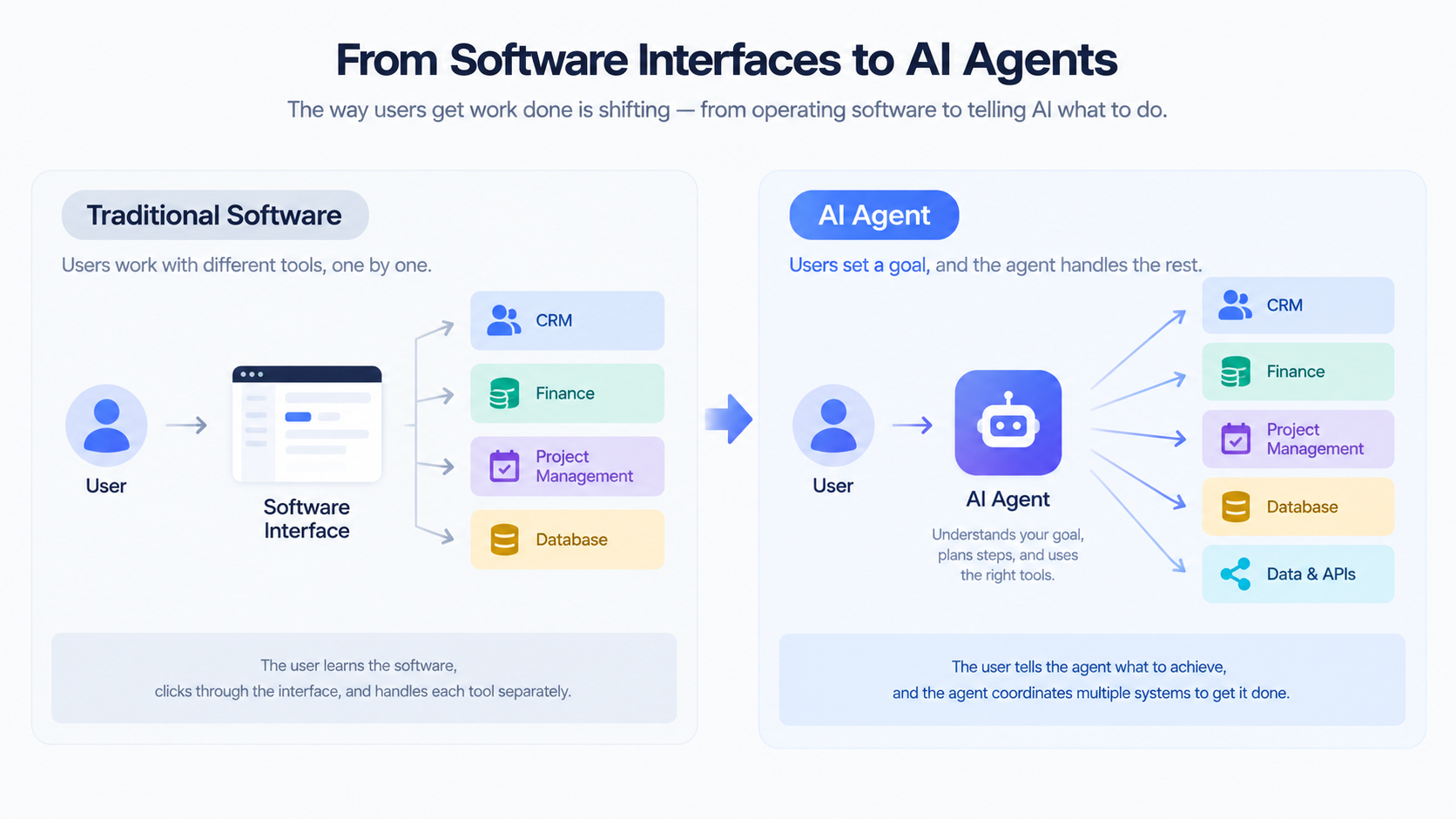
For decades, the software industry operated according to a relatively stable logic. Enterprises needed to manage sales, finance, human resources, customer relationships, projects, and other functions, so software companies built separate tools for each use case. Users opened their CRM to enter customer information, financial software to prepare reports, and project management tools to assign tasks, while constantly switching between email and instant messaging applications. Software’s value was largely defined by its ability to “help people complete a task.”
AI Agents are changing that logic. If an AI Agent can read customer information from a CRM, understand email content, query data in a financial system, and create tasks in a project management tool, users may no longer need to open these applications one by one. They only need to state a goal—for example, “Identify the major customers most likely to churn this quarter and schedule follow-ups for the sales team”—and AI can handle everything else.
This marks an important shift: the purpose of purchasing software may be moving from “getting a tool” to “getting an outcome.” Gartner’s 2026 analysis estimated that Agentic AI could put approximately $234 billion in enterprise application software spending up for reallocation by 2030, representing about 20% of enterprise SaaS spending at that time. The underlying logic is not that enterprises will suddenly stop needing software. Rather, AI Agents can execute tasks across multiple systems, reducing the need for users to operate traditional software interfaces directly.
The question that truly matters, then, is not whether “AI will kill software,” but this: When users no longer need to operate software themselves, where will software’s value come from?
The Most Important Software Entry Point May No Longer Be the Interface
Historically, software competition was largely interface competition. Products that were easier to use, designed workflows more effectively, and offered more intuitive interactions were more likely to win users. For AI Agents, the situation is fundamentally different.
An Agent does not necessarily need to understand an attractive web interface. It cares more about whether it has permission to access data, whether an API is available, whether the data is structured, whether actions can be executed reliably, and whether the system can record the results. That is why software in the AI era may undergo an interesting transformation: the user interface may become less important, while the capabilities of the underlying system become more important.
Consider a company that still needs a CRM to store customer information. An AI Agent can operate the CRM on behalf of employees, but it still needs to know who the customers are, what their historical transactions were, when the latest communication occurred, and when their contracts expire. In this scenario, the CRM interface may no longer be the most valuable asset, but the CRM’s role as the system of record for customer data remains essential.
The same applies to finance, human resources, supply chain management, healthcare, and other fields. AI can help employees read and process information, but it cannot create years of accumulated business data from nothing, nor can it easily replace a core business system that has been validated over many years.
AI’s first impact on software, therefore, may not be that “software disappears.” Instead, software may evolve from a tool users open every day into infrastructure that AI Agents call behind the scenes.
Software That Provides “Only One Function” May Be Most Vulnerable to Disruption
If a software product’s primary value is simply helping users perform a basic operation, the substitution pressure from AI will be more immediate. In the past, a user might have been willing to pay $10 per month for a standalone tool because completing a particular task independently required a great deal of time. But if ChatGPT, Claude, Gemini, or another Agent can perform a similar task directly, the user will reconsider whether that $10 is worth paying.
That is why many AI products are now facing an apparent contradiction: they can acquire paying users more quickly, but they may not retain those users over the long term. RevenueCat’s 2026 subscription app data shows that paying-user revenue is significantly higher for AI apps than for non-AI apps. The median first-year revenue per paying user is $30.16 for AI apps, compared with $21.37 for non-AI apps. Yet the 12-month retention rate for annual subscribers is only 21.1%, versus 30.7% for non-AI apps.
The lesson is clear: “Can AI build it?” is becoming less important. “Why will users continue to use you?” matters more.
If an application simply packages a large model into a chat window, users can easily compare competing products. They can use Product A today and switch to Product B tomorrow without incurring significant switching costs. But if a product has recorded years of user data, understands long-term user behavior, is deeply embedded in enterprise workflows, and continues to accumulate knowledge in a specific domain, the situation is different.
AI lowers the cost of replicating features, but it does not necessarily lower the cost of building these long-term advantages.
The Hardest Things to Replicate Are Shifting From Code to Data and Workflows
In the past, a software company’s technology moat often came from its code. Building a complex system required many engineers, several years of work, and continuous maintenance, making it difficult for new entrants to replicate.
AI coding tools are gradually changing that equation. When AI can help developers generate code, test programs, fix bugs, and even build complete applications, “writing software” itself is becoming cheaper. This does not mean technology is no longer important. It means that simply owning a particular feature may become less likely to create a durable advantage.
Some investment firms have already revised their assessment of this shift. Baillie Gifford’s analysis of software moats in the AI era argues that code is gradually becoming commoditized, while value may increasingly shift toward data, deep integration within customer organizations, and the extent to which software is embedded in specific business processes.
Consider two products. Product A offers a polished AI writing feature that automatically generates articles when users enter their requirements. Product B can also generate articles, but it additionally stores the enterprise’s content assets from the past three years, understands its brand terminology, product information, customer profiles, and review rules, and can send the generated output directly into the CMS, approval system, and marketing workflow.
If the capabilities of the underlying models become increasingly similar, the difference between A and B will no longer be simply “which AI is smarter.” What B truly has is a complete context layer—and context is precisely what general-purpose models find hardest to acquire from scratch.
This explains why future software competition may increasingly revolve around three questions: What data does it control? Which workflows is it embedded in? Can it become more valuable as users spend more time with it?
Software Pricing Models May Also Change
AI’s impact on SaaS also extends to the business model. Traditional SaaS has strongly favored per-seat pricing. An enterprise with 100 employees purchases 100 accounts; in theory, the more employees it has, the more revenue the software company generates. This model made sense because software was primarily used by people.
But if an AI Agent can complete a software workflow that previously required 10 employees to operate, the logic of “10 employees require 10 accounts” becomes less compelling. Enterprises may instead focus on how many tasks the system completed, how many orders it processed, how much labor time it saved, and how many errors it prevented.
Software pricing may therefore gradually shift from “How many users do you have?” to “How much work did the system complete for you?” Deloitte’s 2026 research on SaaS and AI Agents similarly found that as AI Agents become more deeply embedded in enterprise software, traditional subscription and per-seat models may increasingly be combined with pricing based on usage, consumption, and outcomes.
This does not mean subscription pricing will disappear overnight. Subscriptions remain appropriate for many software products. But for AI systems that can execute tasks autonomously, outcomes may become a more direct measure of value than the number of accounts.
The Stronger AI Agents Become, the More “Invisible” Software May Become
This may be the most overlooked aspect of the transformation. In the past, we assumed that excellent software should encourage users to use it more frequently. In the AI Agent era, the opposite may be true. If a system can complete more work automatically, users may not need to open it as often.
An excellent financial Agent should not require finance professionals to open five pages every day, copy 10 sets of data, and fill out 20 fields. It should simply tell them: “There are 17 unusual expenses this month. I’ve categorized them by amount, vendor, and historical records, and three require manual confirmation.”
Users may not even need to know which software the Agent called in the background.
This points to an intriguing future state: the better the software, the less users may need to interact with it directly.
That does not mean the software has less value. It means software is moving from the “interaction layer” toward the “execution layer.” Gartner’s description of this trend is similar: as Agentic AI develops, enterprise users may focus less on traditional software interfaces and more on the business outcomes ultimately produced.
Future software competition may therefore be less about who has the most sophisticated Dashboard and more about who enables users to accomplish the most with the fewest actions.
AI Will Also Struggle to Fully Replace Software Deeply Embedded in Industries
Taken to the extreme, these trends can lead to the conclusion that software will eventually be replaced by Agents because AI can operate software. In practice, the reality is more complicated.
Software used in healthcare, finance, manufacturing, legal services, supply chain management, and other industries is often much more than an interface. It also contains complex data structures, permission systems, compliance processes, industry rules, and business records accumulated over time.
A general-purpose AI can generate a contract, but that does not mean it can directly replace an enterprise’s complete contract management system. An Agent can analyze patient information, but that does not mean it can independently replace a hospital’s core healthcare information system.
The key distinction is whether the software controls foundational data and workflows within an industry that cannot be easily replicated. This is why vertical software is not automatically disadvantaged in the AI era. Menlo Ventures’ analysis of vertical AI software suggests that the key question is not whether AI will disrupt vertical software, but whether a product can go deep into a specific industry and build long-term value around real business processes.
In other words, the stronger AI becomes, the more likely enterprises are to reassess the software they purchase—but that does not mean all software will be eliminated. The products most vulnerable are those that users can easily replace, that lack exclusive data, that are only lightly embedded in workflows, and whose value primarily comes from a simple feature.
The Software Industry’s Real Transformation Is “From Features to Outcomes”
In the past, software companies often told users, “Our product has 100 features.” In the AI era, users may care less and less about that question. What they really want to know is: “What can it do for me?”
This will change both how software products are designed and how startups compete. If an AI product simply adds a chatbot to existing software, its value may quickly be replicated by competitors. But if it can understand enterprise context, call multiple systems, execute complete tasks, and continuously accumulate new data and experience during execution, it is offering more than a feature—it is offering a new way of working.
That is AI’s truly profound impact on the software industry. It is not simply making software less valuable; it is redefining what “software value” means.
Code may become increasingly inexpensive, features may become easier to replicate, and interfaces may become less important. But data, context, permissions, workflows, industry knowledge, and user relationships still require years of accumulation.
The question software companies will ultimately need to answer may therefore no longer be, “Can we build better software?” Instead, it may be:
“Once AI can use nearly every software product on behalf of users, why will it still need us?” This question may become one of the most important product and business challenges facing the software industry over the next several years.
FAQ
What Is an AI Agent?
An AI Agent is an AI system capable of understanding user goals, autonomously calling tools, accessing data, and executing multistep tasks. Unlike traditional software, which relies primarily on manual user operations, an Agent focuses on completing tasks directly based on a goal—for example, organizing customer information, analyzing data, generating reports, or carrying out an entire workflow across multiple software products.
Will AI Agents Replace Traditional SaaS?
In the short term, AI Agents are more likely to change how SaaS is used than to replace SaaS entirely. AI Agents still need underlying software such as CRM systems, financial systems, databases, and project management platforms to provide data, permissions, and business capabilities. The software most likely to face significant pressure is software with limited functionality, weak differentiation, and a primary reliance on manual user operations.
How Will the Core Competitive Advantages of SaaS Change in the AI Agent Era?
The focus of competition may gradually shift from interfaces and feature counts to data, workflows, industry knowledge, system connectivity, and user use cases. For enterprise software, products that accumulate long-term business data, become deeply embedded in complex workflows, and satisfy permission and compliance requirements are generally more difficult to replicate.
Will AI Agents Change SaaS Pricing Models?
They may. Traditional SaaS generally charges based on the number of users or seats, while AI Agents can execute tasks directly. As a result, some products may be better suited to pricing based on the number of calls, task volume, processing scale, or actual output. However, each software product’s business model will continue to be influenced by its cost structure, customer needs, and industry characteristics, so seat-based pricing will not disappear immediately.
Related Articles

What Is ERC-8183? Exploring the AI Agent Commercial Standard and the Infrastructure of the Decentralized Agent Economy

AI Agents Becoming Economic Actors: What Infrastructure Gaps Can Blockchain Fill?

What Is RoboForce? An In-Depth Analysis of the Technical Path and Industrial Prospects of an AI Robotic Workforce Platform

How to Reduce Token Costs in the AI Era: Practical Strategies from Prompt Optimization to Model Selection
What is Athene Network (ATN)? Exploring AI-Blockchain Integration