What Is Stablecoin Checkout? How Citi and Coinbase Connect Stablecoin Payments With Fiat Settlement
Stablecoin Checkout is a digital payment model that uses stablecoins as a payment method, allowing consumers to purchase goods or services with digital assets pegged to the value of fiat currencies. Unlike traditional bank card payments, stablecoin payments can use blockchain networks to transfer assets and connect on-chain funds to merchants’ existing fiat accounts through the conversion and settlement infrastructure provided by payment service providers. This model expands the use of stablecoins beyond crypto asset trading to everyday purchases, business collections, and cross-border commercial payments.
On September 28, 2026, Citi and Coinbase announced an expansion of their collaboration in digital asset payments, focusing on merchant stablecoin acceptance and virtual account-related services. The integration of Coinbase Payments and Spring by Citi enables consumers to pay with stablecoins while allowing merchants to receive fiat settlement through traditional banking infrastructure. This collaboration reflects how traditional financial institutions are exploring ways to integrate blockchain payment capabilities into existing commercial banking services.
This article covers the basic concepts, payment process, and technical mechanisms of Stablecoin Checkout. Using the Citi and Coinbase collaboration as an example, it explains how stablecoins move from consumers’ wallets into merchant settlement systems and analyzes how this payment method differs from traditional bank cards, bank transfers, and cross-border payments. It also examines the practical issues businesses need to consider when adopting stablecoin checkout.
Key Takeaways
-
Stablecoin Checkout is a payment model that allows consumers to pay for goods or services with stablecoins. It typically involves wallet payments, transaction confirmation, asset conversion, and merchant settlement.
-
Citi and Coinbase announced an expanded collaboration in September 2026, with plans to connect stablecoin payments and traditional fiat settlement through infrastructure such as Coinbase Payments and Spring by Citi.
-
Under the merchant payment model announced by the two companies, consumers can pay with stablecoins, while merchants can receive fiat through automatic conversion and bank settlement without directly holding stablecoins.
-
Coinbase Payments is primarily responsible for stablecoin payment processing and related conversion services, while Citi provides merchant payment collection and fiat settlement support through its banking payment infrastructure.
-
Stablecoin payments may provide businesses with new options for cross-border payments and fund transfers, but their actual efficiency still depends on blockchain networks, liquidity, compliance requirements, and banking settlement arrangements.
What Is Stablecoin Checkout? How Does Stablecoin Payment Checkout Work?
Stablecoin Checkout refers to a checkout method in which consumers use stablecoins to pay for goods or services. Unlike traditional bank card payments, stablecoin payments are typically initiated through a digital wallet, with funds transferred over a blockchain network. Stablecoins are generally pegged to fiat currencies such as the U.S. dollar. As a result, they are more suitable for product pricing, everyday payments, and business settlement than more volatile crypto assets such as BTC and ETH.
From a technical perspective, Stablecoin Checkout typically includes payment request generation, wallet authorization, on-chain transaction confirmation, payment status verification, and merchant fund settlement. After a consumer selects stablecoin payment on a merchant’s checkout page, the system can generate a corresponding payment address or wallet interaction request. Once the consumer confirms the transaction, the payment service provider uses the blockchain network to identify whether the funds have arrived and completes the subsequent settlement based on the merchant’s requirements. If the merchant wants to receive fiat directly, the payment platform must also provide stablecoin conversion and withdrawal services to a bank account.
The key value of Stablecoin Checkout lies in embedding on-chain payment capabilities into existing commercial payment processes without requiring every merchant to build its own blockchain infrastructure. By using APIs, wallet connections, transaction monitoring, and automatic conversion provided by payment service providers, businesses can add stablecoin payment options while retaining their existing order management and financial settlement processes. However, on-chain confirmation of a stablecoin transaction and the merchant’s final receipt of fiat are not the same process. The latter may still be affected by banking hours, compliance reviews, and conversion liquidity.
What Is the Citi × Coinbase Stablecoin Payment Collaboration?
On September 28, 2026, Citi and Coinbase announced an expanded collaboration in digital asset payments aimed at helping businesses connect more conveniently to traditional banking services and blockchain payment networks. According to the companies’ official announcement, the collaboration primarily covers two services: supporting merchant stablecoin acceptance through Spring by Citi and Coinbase Payments, and using Citi Virtual Account Wallet to provide banking infrastructure for Coinbase Virtual Accounts. These two services address, respectively, the integration of stablecoins into traditional commercial payment scenarios and the flow of fiat into digital asset systems.
For merchant payment collection, Citi plans to provide institutional clients with stablecoin checkout capabilities through Spring by Citi, while Coinbase Payments will handle stablecoin payment processing and automatic conversion. Consumers can pay with stablecoins, while merchants ultimately receive fiat settlement through Citi without needing to hold, custody, or manage digital assets themselves. This model reduces the operational complexity of direct crypto asset exposure for businesses and enables stablecoins to enter commercial payment scenarios through existing banking payment infrastructure.
At the same time, Coinbase selected Citi’s Virtual Account Wallet as the underlying banking service for Coinbase Virtual Accounts. Businesses can use these virtual accounts to receive, hold, and pay fiat funds, and automatically convert received fiat into stablecoins. Unlike the merchant stablecoin acceptance service, this functionality is more focused on business treasury management and fiat funding. Together, the two services create a two-way connection between traditional finance and digital assets. The companies stated that the services will initially launch in the United States, with plans to expand additional functionality. However, the full launch scope and specific timeline remain subject to subsequent announcements.
How Does Stablecoin Checkout Enable Stablecoin Payments and Fiat Settlement?
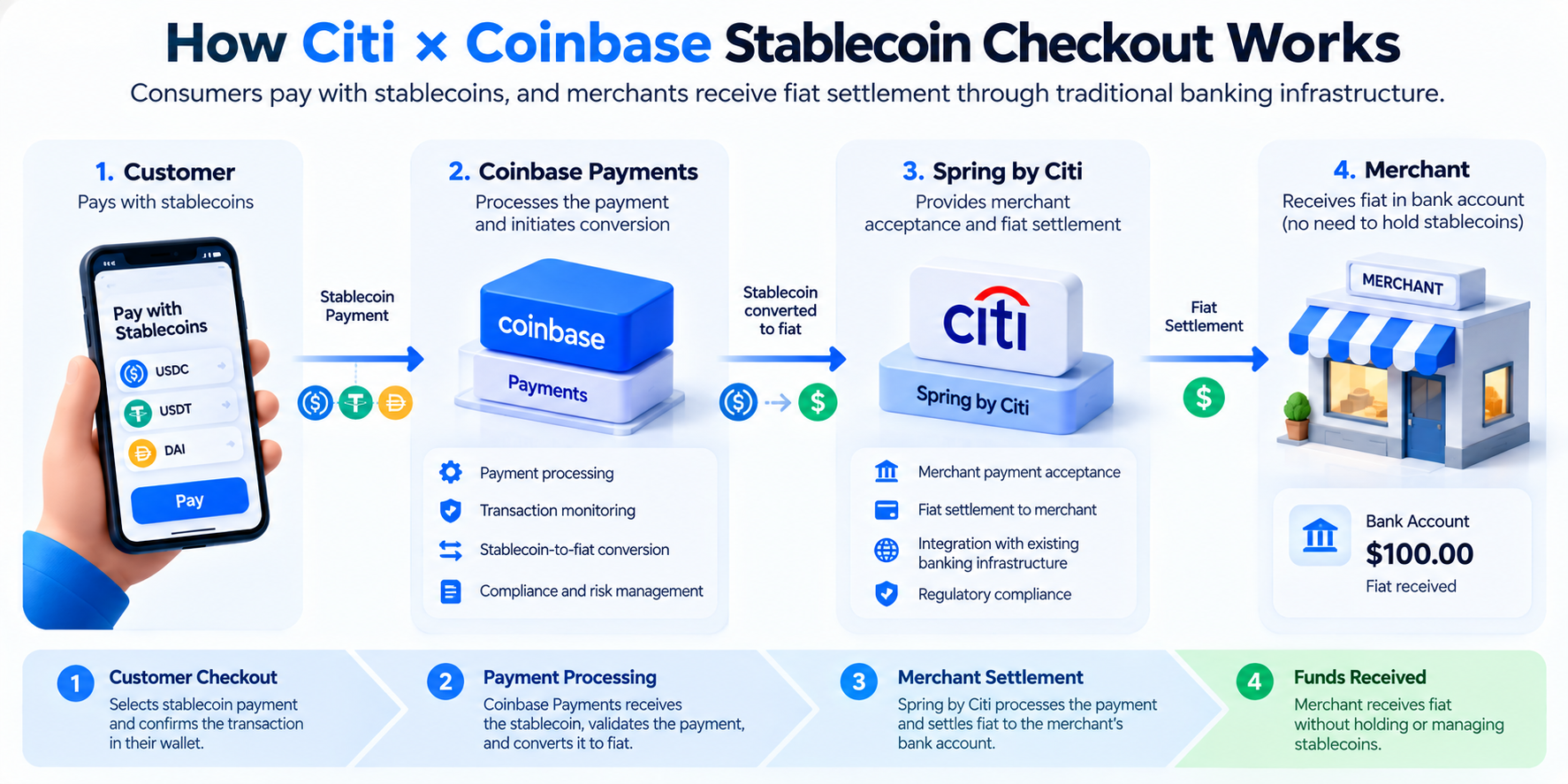
Under the collaboration model announced by Citi and Coinbase, stablecoin payments and fiat settlement are completed through two interconnected infrastructure layers. After a consumer selects stablecoins as the payment method on a merchant’s checkout page, Coinbase Payments provides digital asset payment processing and handles the receipt and conversion of the relevant stablecoins in accordance with the transaction flow. Citi then uses Spring by Citi and its banking settlement system to settle the converted fiat funds to the merchant.
This process can be understood as a consumer paying with stablecoins while the merchant continues to receive funds through traditional financial channels. For example, a consumer purchases goods worth $100 and selects a U.S. dollar stablecoin as the payment method on a supported merchant payment page. After the payment service provider processes the on-chain payment, it converts the stablecoin into fiat based on the applicable exchange rate and fees, and the merchant receives the corresponding funds through bank settlement. The $100 example is provided for illustrative purposes only and does not represent specific fees or an actual settlement amount disclosed by Citi or Coinbase.
The key feature of this model is that the payment asset and the merchant’s settlement asset can be different. Traditional crypto asset acceptance generally requires merchants to receive digital assets directly and decide when to convert them into fiat. Stablecoin Checkout can use a payment service provider to process the conversion automatically, reducing the need for merchants to manage wallets, private keys, and stablecoin positions directly. Coinbase states that its payment infrastructure can provide stablecoin acceptance, conversion, treasury management, and fiat on-ramp and off-ramp services, enabling businesses to process digital asset payments through a unified service interface.
However, completion of an on-chain payment does not mean that fiat will arrive at the same time. A stablecoin transaction may receive blockchain confirmation relatively quickly, while subsequent conversion, compliance review, and bank fund settlement remain separate steps. Therefore, when evaluating Stablecoin Checkout, businesses need to consider both on-chain transaction speed and the time until the final fiat funds become available, rather than treating the two as the same measure of settlement efficiency.
What Roles Do Spring by Citi and Coinbase Payments Play?
Spring by Citi is an integrated payment acceptance platform provided by Citi for commercial payment scenarios. It supports businesses in handling merchant payment collection and settlement requirements through banking infrastructure. In the stablecoin collaboration, Spring by Citi primarily provides payment access and merchant services on the traditional finance side. This enables Citi’s institutional clients to add stablecoin payment options within their existing commercial payment systems without having to build a complete digital asset custody and settlement system themselves.
Coinbase Payments is primarily responsible for digital asset payment infrastructure, including stablecoin payment processing, on-chain fund transfers, and related conversion capabilities. By connecting these functions with Spring by Citi, Coinbase can extend stablecoin payment services to business customers using traditional banking services, while Citi can use Coinbase’s digital asset technology to provide merchants with a new payment method. The collaboration does not simply involve a bank issuing stablecoins. Instead, it integrates on-chain payments and fiat settlement into a continuous commercial process through the division of expertise between different institutions.
This division of responsibilities reflects the direction in which stablecoin payment infrastructure is developing: blockchain networks handle digital asset transfers, payment service providers handle payment processing and conversion, and banks provide regulated fiat accounts and settlement services. Businesses do not need to take on all technical and compliance responsibilities independently, but they still need to complete the necessary account opening, identity verification, and risk management procedures based on local laws, business type, and service provider requirements.
Why Can Merchants Accept Stablecoins Without Directly Holding Crypto Assets?
Traditional crypto asset acceptance generally requires merchants to maintain a digital wallet and manage BTC, ETH, or stablecoins after receiving them. This means businesses may need to establish processes for private key management, digital asset accounting, transaction monitoring, and fiat conversion. For businesses that primarily operate in U.S. dollars or other fiat currencies, directly holding digital assets may increase the complexity of treasury management and internal controls.
Stablecoin Checkout separates stablecoin acceptance from fiat settlement through a payment service provider. After a consumer completes a payment with stablecoins, the payment infrastructure receives and processes the relevant digital assets and automatically converts them into fiat based on the service arrangement. The merchant ultimately receives funds through bank settlement, so it does not need to hold stablecoins long term or manage private key custody on a daily basis simply to accept stablecoin payments. In the Citi and Coinbase collaboration, this functionality is a core feature of Merchant Stablecoin Acceptance.
However, merchants not directly holding stablecoins does not mean that the payment process is entirely free of digital asset risks. Before conversion, stablecoins may still be exposed to depegging, blockchain network failures, or insufficient liquidity. Payment service providers must also manage operational risks associated with conversion and transaction processing. The party responsible for specific risks depends on the service agreement, conversion timing, and settlement arrangements. Businesses therefore still need to assess the payment service provider’s risk management capabilities and contract terms rather than using the final receipt of fiat as the only measure of payment security.
How Does Stablecoin Checkout Differ From Credit Card and Traditional Cross-Border Payments?
The main difference between Stablecoin Checkout and traditional payment methods lies in the underlying fund transfer networks and settlement mechanisms. Credit card payments generally rely on issuers, acquirers, and card networks to complete authorization, clearing, and settlement. Stablecoin payments can transfer digital assets directly over a blockchain network, after which a payment service provider handles conversion and merchant settlement. Both methods can provide consumers with a relatively simple payment interface, but their underlying fund processing methods differ significantly.
In cross-border payment scenarios, traditional bank transfers may involve correspondent banks, cross-border clearing networks, and banking hours in different countries. Stablecoins can be transferred around the clock on supported blockchain networks and therefore have the potential to improve the efficiency of certain cross-border fund transfers. However, cross-border stablecoin transfers do not mean that every payment step can be completed instantly. In particular, when the recipient needs to convert stablecoins into local fiat, the process still depends on compliant conversion services and the local banking system.
| Comparison Dimension | Stablecoin Checkout | Credit Card Payment | Traditional Cross-Border Bank Transfer |
|---|---|---|---|
| Payment Instrument | Stablecoins and digital wallets | Credit and debit cards | Bank accounts |
| Underlying Network | Blockchain and payment service providers | Card networks and banking networks | Banks and cross-border clearing networks |
| Fund Processing | On-chain transfer, with optional automatic conversion | Authorization, clearing, and settlement | Interbank fund transfer |
| Operating Hours | Blockchains generally support 24/7 operation | Payment authorization is generally available around the clock | Depends on banks and payment systems |
| Refund Mechanism | Usually requires an additional refund transaction | Generally has established refund and dispute resolution processes | Depends on banking and transfer rules |
| Main Costs | Network fees, conversion fees, and service fees | Merchant fees and related charges | Transfer fees, exchange rates, and correspondent bank fees |
From a business perspective, Stablecoin Checkout is not necessarily superior to credit cards or bank transfers in every scenario. For merchants that already have a mature bank card payment system, adding stablecoin payment options may primarily serve to reach new user groups rather than replace existing payment networks entirely. The appropriate payment method still needs to be evaluated based on user needs, transaction volume, regional coverage, and fund settlement costs.
What Risks and Limitations Does Stablecoin Checkout Face?
Although stablecoin payments can use blockchain networks to transfer funds, their security and stability are still affected by factors such as the stablecoin issuer’s mechanisms, the underlying blockchain, and the operational capabilities of payment service providers. The first risk is depegging. Even though stablecoins are generally pegged to fiat currencies such as the U.S. dollar, their market prices may deviate due to changes in reserve assets, redemption liquidity, or market confidence. If a payment service provider cannot complete the conversion at the expected exchange rate, the final settlement amount may be affected.
The second risk involves the irreversible nature of on-chain transactions and operational errors. If a consumer uses the wrong blockchain network, enters an incorrect address, or transfers funds to an unsupported payment contract, the funds may not arrive properly. Unlike traditional credit card transactions, blockchain transfers generally do not have a standardized chargeback mechanism executed directly by the network. Stablecoin payment platforms therefore need to establish independent refund, transaction exception handling, and customer support processes.
Regulatory compliance and service coverage are also important limitations. Stablecoin payments may involve anti-money laundering (AML), know-your-customer (KYC), sanctions screening, and payment service licensing requirements. Regulatory standards for stablecoins also vary across jurisdictions. The related services announced by Citi and Coinbase are initially planned for launch in the United States, which does not mean that all countries, merchants, or stablecoins are already supported. Before integration, businesses still need to confirm specific service eligibility, supported networks, fee structures, and settlement terms.
What Does the Citi × Coinbase Collaboration Mean for the Stablecoin Payment Market?
The collaboration between Citi and Coinbase reflects how stablecoins are gradually moving from being fund transfer tools in the crypto asset trading market into traditional commercial payments and business treasury management. In the past, stablecoins were primarily used for exchange fund transfers, DeFi activities, and on-chain asset settlement. As payment infrastructure continues to improve, their use cases are expanding to merchant collections, business payments, and cross-border fund transfers.
The importance of this collaboration lies not only in adding a new checkout method but also in connecting stablecoin payments with regulated banking infrastructure. Merchants can allow consumers to pay with stablecoins while businesses continue to receive fiat through familiar bank accounts. This lowers the technical barrier to directly managing digital assets and provides a reference infrastructure model for bringing stablecoins into broader commercial scenarios.
From an industry development perspective, Stablecoin Checkout also demonstrates the complementary relationship between traditional finance and blockchain technology. Banks have established account systems, compliance capabilities, and business customer bases, while crypto payment service providers can provide on-chain asset transfers, wallet connections, and digital asset conversion capabilities. Combining these capabilities may improve interoperability between traditional payment systems and digital asset networks. However, whether stablecoin payments can achieve large-scale adoption still depends on actual merchant demand, the regulatory environment, consumer experience, and long-term operating costs. Adoption cannot be determined solely based on a financial institution’s collaboration announcement.
Conclusion
Stablecoin Checkout is a digital payment model that uses stablecoins to pay for goods or services and relies on payment infrastructure to process subsequent fund settlement. Its core value is enabling consumers to pay with on-chain assets while allowing merchants to choose stablecoins or fiat as the final settlement asset based on their needs.
In September 2026, Citi and Coinbase expanded their collaboration, providing a new practical direction for this model. Through the integration of Coinbase Payments and Spring by Citi, stablecoin payments can connect to traditional banking merchant settlement systems, allowing businesses to add stablecoin payment options without directly holding digital assets. At the same time, Coinbase Virtual Accounts further connect business fiat accounts with stablecoin conversion processes.
However, stablecoin payments do not operate independently of the traditional financial system. Their actual operation still requires consideration of asset conversion, bank settlement, regulatory compliance, and payment security. As banks and digital asset service providers continue exploring the integration of payment infrastructure, Stablecoin Checkout may become an important way to connect traditional commercial payments with on-chain finance.
FAQ
What Is Stablecoin Checkout?
Stablecoin Checkout is a payment method that allows consumers to use stablecoins to purchase goods or services. Consumers initiate payments through digital wallets, while payment service providers process on-chain transactions and complete settlement in stablecoins or fiat based on the merchant’s requirements.
How Does Stablecoin Checkout Work in the Citi and Coinbase Collaboration?
Under the collaboration model announced by the two companies, consumers pay with stablecoins, Coinbase Payments handles stablecoin payment processing and automatic conversion, and Citi provides merchants with fiat settlement through Spring by Citi. Merchants do not need to directly hold or manage stablecoins.
Do Merchants Using Stablecoin Checkout Need to Hold USDC?
Not necessarily. Under the merchant stablecoin acceptance model announced by Citi and Coinbase, merchants can receive fiat through automatic conversion without directly holding stablecoins. The companies have not yet announced a complete list of supported assets for the collaboration, so it cannot be assumed that the service supports USDC only.
Is Stablecoin Checkout Faster Than Credit Card Payments?
Stablecoins can use blockchain networks to transfer funds around the clock, but actual payment speed depends on network confirmation, payment service provider processing, asset conversion, and bank settlement. Some scenarios may offer speed advantages, but not all stablecoin payments are guaranteed to be faster than credit card payments.
Is the Citi × Coinbase Stablecoin Payment Service Available Globally?
No. According to the official announcement dated September 28, 2026, the companies plan to launch the related services first in the United States and expand functionality later. The specific launch date, supported regions, merchant eligibility, and supported assets are subject to the latest official information from Citi and Coinbase.
Related Articles

Will Sidra Break $1,000? A Realistic Look at Sidra Chain Price Claims in 2026–2027

BlockDAG (BDAG): A High-Speed and Secure Layer 1 for the Next Era

Rising Prices but Bearish Funding Rates: Is Crypto Entering a “Layered Bull Market” After Wall Street Capital Inflows?

Fractional NFTs: Lowering Barriers and Enhancing Liquidity
What is USDC? A Complete Guide to One of the Most Trusted Stablecoins