

Search Token/Wallet
Epochal’s Trillion-Page Index: Why High-Quality Data Is Becoming AI’s New Competitive Moat
Beginner
AIOn November 24, 2026, Epochal, an AI startup founded by several former core team members of xAI, officially launched its first product, [Time Portal](https://epochal.com/blog/building-the-time-portal-engine). Built on a temporal index covering more than 1 trillion web pages and over 30 years of internet history, the product allows AI agents to retrieve information from specific points in history and perform analysis and forecasting tasks within the corresponding information environment.
Unlike traditional search engines, which primarily help users obtain current information, Epochal attempts to address a different question: If AI can use only information that existed at a particular point in history, can it make effective judgments about events that have not yet occurred?
The launch of this product also reflects a shift in the dimensions of competition within the AI industry. In the past, the market focused more on GPU computing power, model parameter size, and inference performance. As foundation model capabilities continue to improve, obtaining data with differentiated value and converting it into verifiable training environments is becoming a new area of industry competition.

## Key Takeaways
- Competition over AI data is shifting from scale to quality: As model capabilities continue to improve, data accuracy, uniqueness, temporal completeness, and verifiability are becoming important factors affecting model capabilities.
- Historical data has value distinct from that of static corpora: By building an internet index with a temporal dimension, Epochal enables AI to perform analysis and make decisions within specific historical information environments.
- Forecasting capabilities may become an important direction for AI development: Compared with answering questions that already have clear answers, forecasting future events requires AI to process incomplete information, uncertainty, and dynamic changes.
- Data infrastructure is developing independent industry value: Web crawling, historical version management, data cleaning, temporal retrieval, and permission management may become important infrastructure for the AI industry.
- Data scale does not directly equal model competitiveness: High-quality data still needs to be combined with model architecture, training methods, computing resources, and commercial applications to create a sustainable competitive advantage.
## What Exactly Is Epochal’s Trillion-Page Web Index?
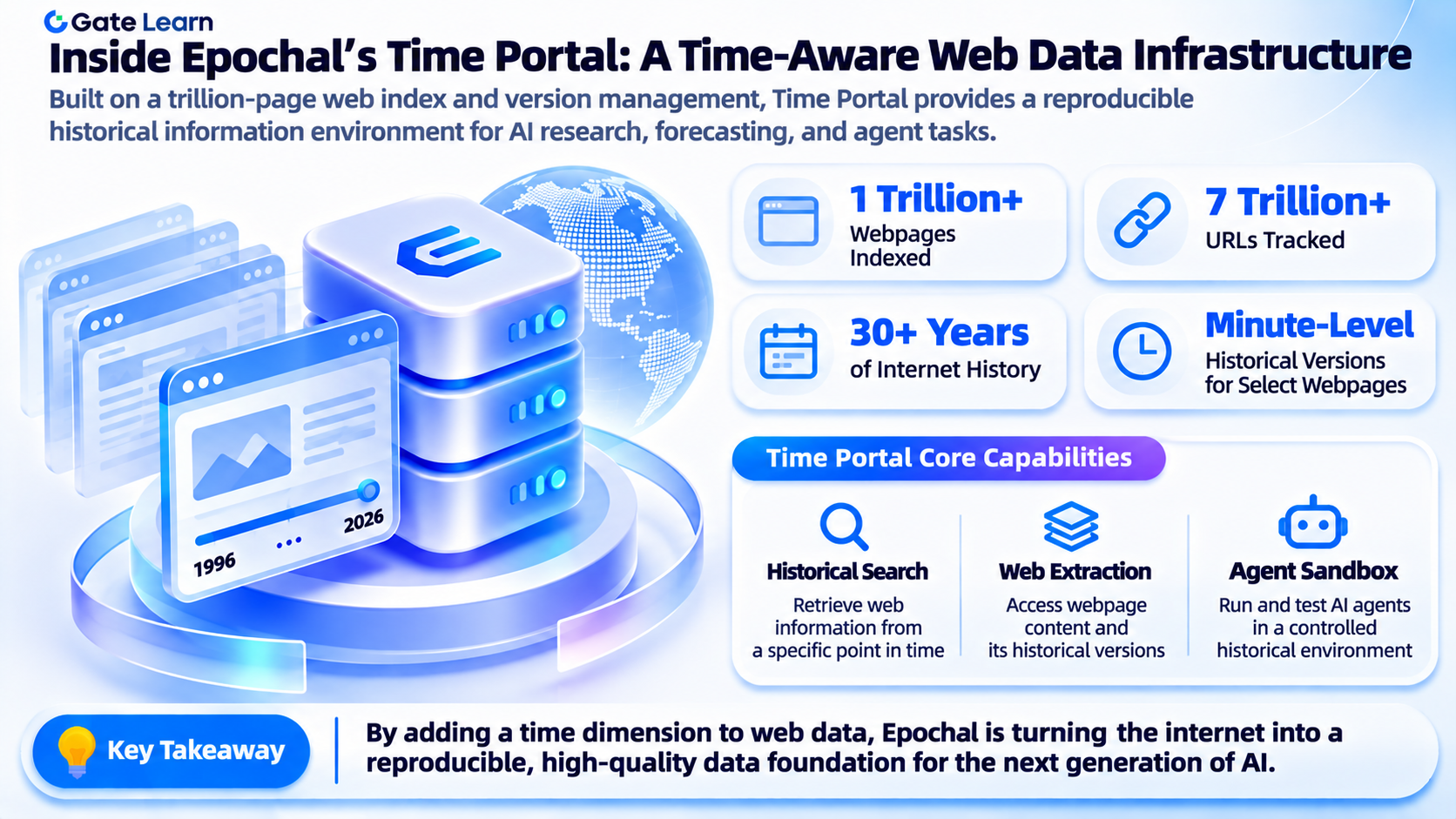
Epochal is an AI company focused on developing AI forecasting capabilities. Its first product, Time Portal, is not a traditional chatbot or general-purpose large language model, but a historical internet environment designed for AI agents.
At the time of the product launch, Time Portal disclosed the following infrastructure figures:
- More than 1 trillion accessible web pages;
- More than 7 trillion tracked URLs;
- Coverage spanning more than 30 years of internet history;
- Minute-level historical version records for some frequently updated web pages.
These figures do not mean that Epochal owns 1 trillion manually labeled AI training samples, nor do they mean that all web pages have complete minute-level historical records. Its core assets are internet archives with temporal attributes, along with the retrieval and access capabilities built around those archives.
Time Portal provides three types of interfaces: historical search, webpage extraction, and an agent sandbox. These interfaces allow developers to limit the information available to AI and test its analytical capabilities at specified points in history.
The commercial value of this system does not come entirely from data scale. It also lies in converting historical information that is dispersed, constantly changing, and difficult to reproduce into a research environment that AI systems can access repeatedly.
## Why Is Traditional Internet Data Insufficient for AI Forecasting?
Traditional large language models typically learn language structures, knowledge relationships, and connections between different concepts from large volumes of text. This training method helps models answer factual questions, generate content, and complete certain complex reasoning tasks.
However, when AI is used to forecast future events, ordinary internet data may have significant limitations.
For example, researchers may want to test whether AI can determine if a technology company’s performance is likely to exceed market expectations before the company releases its earnings report in 2024. If AI directly uses a current search engine for research, it may retrieve news, analyst reports, and stock price performance published after the earnings report, thereby gaining access to the actual outcome in advance.
In this situation, even if AI provides the correct answer, that does not prove that it has genuine forecasting capabilities, because it may simply be using hindsight to reinterpret an event that has already occurred.
This issue is commonly known as look-ahead bias or information leakage across time. It is particularly important in financial strategy backtesting, machine learning research, and model capability evaluation.
Ordinary internet data also frequently faces another problem: webpage content changes over time. News articles may be continuously updated after a breaking event, corporate financial data may be revised, and policy documents may have multiple versions. Without historical snapshots, it is difficult for researchers to accurately determine whether specific information had been publicly available at a particular point in the past.
Therefore, data used for forecasting tasks needs to contain not only facts, but also the times when those facts were recorded, published, and disseminated.
## Why Is the Temporal Dimension Becoming an Important Attribute of AI Data?
Traditional knowledge data is generally used to answer what a fact is. Temporal data goes further by recording when a fact emerged, how it changed, and what information could be observed at a specific point in time.
Consider the financial markets. A publicly traded company may first release preliminary earnings guidance, then publish its official earnings report, and finally adjust its future operating outlook during an earnings call. Although these three stages all concern the same company, the information available to market participants is not the same at each stage.
If all this content is placed into the same static dataset, AI may be able to accurately summarize changes in the company’s operations, but it will not be able to distinguish which judgments could have been made before the earnings report from which conclusions could be formed only after subsequent information became available.
A time-constrained data environment can preserve these differences in information. Researchers can ask AI the same question at different points in time and observe how the model adjusts its judgment as new information emerges.
This capability applies not only to financial research. In policy analysis, scientific experiments, supply chain management, public event forecasting, and corporate decision-making, the time at which information becomes available can also directly affect analytical results.
From this perspective, the definition of high-quality data is changing. In addition to content authenticity and accuracy, temporal completeness, historical versions, and the traceability of information sources may also become important factors determining data value.
## Why Is AI Data Infrastructure Becoming More Complex, From Web Crawling to Temporal Indexing?
Building an internet index with temporal attributes is not simply a matter of saving a large number of web pages to a database.
The internet itself is a constantly changing information environment. The same webpage may be updated multiple times in a single day, or it may remain unchanged for years. The same news content may be reposted by multiple websites, while some webpages may disappear permanently because a website shuts down or the content is deleted.
As a result, historical data infrastructure needs to address data collection, storage efficiency, content deduplication, version identification, and historical retrieval at the same time.
Epochal’s technical architecture uses webpage version chains to link the content of a specific URL across different points in time. It also reduces duplicate data through deduplication across webpages and across time.
In the week ending November 20, 2026, approximately 56% of the webpages being processed for indexing, according to Epochal, formed new historical versions. The remaining approximately 44% consisted of duplicate content across URLs or repeated crawls of content that already existed on the same webpage.
This means that there is a significant difference between the scale of raw crawling and the amount of genuinely new and useful information. If a company cannot effectively identify duplicate content, expanding its crawling operations may primarily increase storage and computing costs rather than create more valuable data assets.
In addition, historical search systems need to prevent future versions of content from being returned for past queries and should ensure, as much as possible, that search results remain stable across different points in time.
As AI agents begin to perform more complex research tasks, competition in data infrastructure will also extend beyond basic information storage to data organization, real-time updates, historical reconstruction, and retrieval efficiency.
## Why Doesn’t More Data Necessarily Mean a Smarter AI Model?
Over the past few years, the development of large language models has benefited substantially from the simultaneous expansion of training data, model parameters, and computing resources. However, once data volume reaches a certain level, adding more data may not produce a proportional improvement in capabilities.
- Internet information contains significant amounts of duplicate content. The same news article may be reposted by dozens of websites, similar product descriptions may appear on multiple pages, and large amounts of automatically generated content may use highly similar wording. If this content is repeatedly included in training data, its incremental knowledge value may be relatively limited.
- Data quality directly affects model learning outcomes. Incorrect information, outdated knowledge, context-deficient text, and data from unknown sources may make model training more difficult and affect the reliability of its outputs.
- Different types of data have different training value. Large amounts of ordinary text can help models improve their language understanding, but for tasks such as advanced mathematical reasoning, financial research, professional programming, and scientific forecasting, models may need specialized data with complete structures and clear verification conditions.
Therefore, future differences between AI companies may no longer be reflected solely in how much training data they use. Instead, they may be reflected in whether they can obtain data with unique value and convert it into effective capabilities through appropriate filtering, organization, and training methods.
The significance of a trillion-page web index is not merely to demonstrate that internet data remains massive in scale. It also shows that the same internet content can provide application value distinct from that of ordinary text corpora when reorganized along a temporal dimension.
## Why Is AI Moving From Knowledge Q&A to Forecasting and Decision-Making?
AI can now complete a wide range of knowledge retrieval, content generation, and information summarization tasks. However, real-world business activities generally require more than knowing what has already happened.
Companies need to determine whether future market demand will increase. Financial institutions need to assess whether credit risk will deteriorate. Supply chain managers need to forecast changes in orders and inventory. For these tasks, the information available to AI is typically incomplete, and the final outcome has not yet been determined.
This creates a clear difference between forecasting tasks and traditional knowledge Q&A.
Knowledge Q&A mainly relies on information retrieval, factual understanding, and accurate expression. Forecasting tasks also require identifying the key variables that affect an event’s outcome, assessing the probability of different scenarios, and continuously adjusting judgments as new information emerges.
For example, AI can summarize a company’s financial reports from the past three years. However, if it needs to forecast the company’s revenue for the next quarter, it must further analyze industry demand, order changes, operating costs, the competitive environment, and management expectations. These variables may have complex relationships, and a change in any one of them could invalidate the original judgment.
By using historical information environments as infrastructure for AI training and evaluation, Epochal essentially provides a way to study model decision-making: The model makes a judgment without knowing the final outcome, and its performance is then evaluated using facts that occurred later.
However, the ability to build such a training environment does not mean that AI already has stable and accurate forecasting capabilities. Forecasting quality still depends on the model itself, the information available, task difficulty, and evaluation methods.
## How Can Historical Internet Environments Help AI With Reinforcement Learning?
Reinforcement learning is a type of machine learning in which a model gradually improves its decision-making capabilities by performing tasks, receiving feedback, and adjusting its behavior.
In mathematics and programming, many tasks have relatively clear verification standards. For example, whether a mathematical answer is correct or whether a program passes tests can provide feedback to the model.
Real-world forecasting tasks are more complex. Actual results for corporate earnings, policy changes, economic data, and market events often become available only after a period of time, making it relatively costly to conduct large numbers of forecasting experiments in real time.
Historical information environments provide an alternative research path. Developers can set a point in the past for AI, limit the information it can use, have the model analyze data that was publicly available at that time, and ask it to forecast subsequent events. They can then use the actual historical outcomes to evaluate the quality of its judgments.
In this process, Time Portal primarily serves as environmental infrastructure rather than directly providing a trained forecasting model.
For probabilistic forecasting tasks, evaluation cannot focus only on whether the final judgment was correct. For example, if a model assigns a 60% probability to an event, the fact that the event ultimately did not occur does not by itself establish that the forecasting process was incorrect. Researchers need to observe a large number of tasks to determine whether the model’s probabilistic judgments are well calibrated and whether it can consistently handle different levels of uncertainty.
In addition, if the foundation model encountered the outcome of the target event during pretraining, limiting external searches alone cannot completely eliminate information leakage. Therefore, historical environments need to be combined with the foundation model’s knowledge cutoff date, test data isolation, and training sample management to create a more reliable evaluation mechanism.
## Why May High-Quality Data Be More Difficult to Replicate Than the Model Itself?
Differences in capabilities between AI models are not fixed. As open-source technology, model distillation, training method optimization, and computing efficiency improve, some model capabilities may gradually become common industry resources.
By comparison, some data assets with unique attributes may be more difficult to replicate.
- Historical data has temporal irreversibility. A company can begin crawling internet content today, but it cannot guarantee that it will recover webpages deleted in the past, historical data that has been overwritten, or versions of information that were never saved.
- Specialized data has high acquisition and organization costs. For example, financial transaction records, medical research data, industrial equipment operating data, and internal corporate operating information generally require long-term accumulation and involve data authorization, privacy protection, and industry expertise.
- Data assets also require continuous maintenance. Only after original data has undergone quality screening, structured processing, source verification, and permission management can it be used more effectively in AI applications.
For companies with stable data sources, long-term value may come not only from the data they have already accumulated, but also from their ability to continuously obtain new information. If a company can generate data feedback through its actual business and continually improve its products and model performance, it may establish a competitive advantage with cumulative effects.
However, data barriers are not inherently exclusive. Public internet information can be accessed by multiple companies, and competitors may establish similar capabilities through data partnerships, technological innovation, and alternative data sources. Whether a company can build a genuine competitive barrier still depends on the uniqueness of its data, acquisition costs, and customer switching costs.
## How Will Competition Over AI Data Change Value Distribution Across the Industry Chain?
In the past, market attention in AI infrastructure focused mainly on chip manufacturing, GPU computing power, data centers, and cloud computing. These segments provide the computing resources required for model training and inference.
As AI applications move into increasingly specialized scenarios, the value of other segments in the industry chain may increase further.
Computing infrastructure addresses whether a model can perform large-scale computations. Data infrastructure addresses what information the model can use. Models and agents are responsible for converting computing resources and data into specific analytical and decision-making capabilities.
As the capabilities of general-purpose models gradually improve, competition between companies may increasingly focus on data acquisition, business knowledge, tool connectivity, and the ability to complete real-world tasks.
For example, even if two financial research institutions use the same foundation model, their resulting analytical products may still differ significantly if one of them has more complete historical financial data, industry supply chain order information, and verified research records.
Similar competitive dynamics may also emerge in healthcare, law, manufacturing, and enterprise software. Companies with business data, specialized knowledge, and real-world application scenarios may have opportunities to use AI to convert existing data resources into new product capabilities.
This means that value distribution in the AI industry may no longer revolve entirely around model scale and computing resources. Data collection, specialized corpus licensing, real-time information retrieval, historical databases, and model evaluation tools may also become more important commercial components.
## How Will Historical Data Infrastructure Affect Financial Research and Prediction Markets?
Financial markets are one area where historical information environments may have significant potential value.
Traditional financial strategy backtesting generally relies on historical prices, financial metrics, and trading data. However, if a strategy uses news, policy documents, or corporate announcements as the basis for decision-making, researchers also need to consider whether the relevant information had been made public at the time and whether it was later revised.
Historical internet indexes can help researchers build test tasks that more closely resemble real-world decision-making environments. For example, before a Federal Reserve meeting, AI could be asked to combine inflation data, employment reports, policy statements, and market expectations that had already been released at that time to produce a probability judgment regarding the interest-rate decision.
In prediction markets, similar methods can be used to evaluate AI’s ability to analyze political, economic, technological, and other events. Historical questions can provide event outcomes that have already been determined, while historical information environments can limit the information available to the model.
However, financial forecasting and actual trading profitability are still clearly different. Even if a model can accurately estimate the probability of an event, it may not create an effective trading advantage if the market price has already fully reflected that information or if trading costs exceed potential returns.
Forecasting results also need to account for market liquidity, trade execution, contract settlement rules, and risk management.
Therefore, the primary value of historical data infrastructure is to help researchers evaluate information analysis and decision-making capabilities more rigorously, not to guarantee that AI can accurately forecast market prices or generate sustainable investment returns.
## What Other Challenges Does Data-Driven AI Competition Face?
Although the importance of high-quality data is increasing, data infrastructure still faces a range of commercial and technical challenges.
Data licensing is an important issue. The fact that internet content can be accessed publicly does not mean that it can be freely copied, stored long term, or used to train commercial models in all jurisdictions. Different data sources may involve copyright, website terms of use, personal privacy, and other legal requirements.
The completeness of historical data also has limitations. Web crawling frequency, access permissions, and network conditions all affect data coverage. Even an index containing trillions of webpages may not be able to fully reconstruct all historical information, much less cover facts that were not publicly available at the time.
Cost is another important factor affecting commercial sustainability. Large-scale web crawling, historical version storage, and high-concurrency retrieval require continued investment in computing, network, and storage resources. If customer demand cannot cover operating costs, the size of a massive database may also become a financial burden for a company.
Therefore, when assessing whether an AI data company has long-term competitiveness, it is necessary to consider whether its data sources are lawful and stable, whether its information provides differentiated value, whether retrieval costs can continue to decline, and whether its products can generate genuine commercial demand.
High-quality data can become a commercial barrier rather than merely a technical asset only when it can continuously create value for customers.
## Conclusion
Epochal’s trillion-page web index demonstrates a new direction for the development of AI data infrastructure. By preserving historical versions and temporal attributes of internet information, webpages that were originally used mainly for knowledge retrieval can become foundational resources for forecasting tasks, agent training, and model evaluation.
As artificial intelligence expands from content generation into complex analysis and decision-making scenarios, competition over data may no longer be limited to the quantity of training corpora. Greater emphasis may be placed on information accuracy, uniqueness, temporal completeness, and verifiability. Companies with stable data sources and specialized processing capabilities may also establish new competitive advantages within the AI industry chain.
However, high-quality data cannot replace model capabilities, algorithmic innovation, or computing infrastructure. The long-term competitiveness of AI companies will still depend on whether data, computing power, models, and commercial applications can form a mutually supportive system and ultimately be converted into sustainable product value.
## FAQ
### What Is Epochal?
Epochal is an AI startup focused on AI forecasting capabilities. Its first product, Time Portal, provides an internet retrieval and agent execution environment with temporal constraints.
### Is Epochal’s Trillion-Page Web Index an AI Training Dataset?
Not exactly. It is primarily an internet index with historical versions and temporal attributes. It can provide a data access environment for AI training, forecasting experiments, and model evaluation, but it is not equivalent to a fully processed model training dataset.
### What Is Look-Ahead Bias?
Look-ahead bias refers to using information that was not available at the time in historical analysis or strategy backtesting, making the test results unable to accurately reflect real-world decision-making capabilities.
### Why Could High-Quality Data Become a Competitive Barrier for AI?
Data with unique characteristics, high accuracy, temporal completeness, and lawful usage rights generally requires long-term accumulation and specialized processing. Competitors may find it difficult to replicate such data in a short period of time.
### Can Historical Data Help AI Accurately Forecast the Future?
Historical data can help AI learn and evaluate decision-making processes, but it cannot guarantee accurate forecasts. Future events are still affected by incomplete information, changing environments, and unpredictable factors.
Does AI Still Need Large Amounts of GPU Computing Power?
Yes. High-quality data and computing power are complementary resources. Data determines what information a model can learn and use, while computing power supports model training, inference, and the execution of complex tasks.
### Can Epochal’s Technology Be Used in Financial Markets?
Its historical information environment has potential applications in financial research, strategy backtesting, and event probability forecasting. However, forecasting capabilities are not directly equivalent to trading profitability.
* The information is not intended to be and does not constitute financial advice or any other recommendation of any sort offered or endorsed by Gate Web3.
* This article may not be reproduced, transmitted or copied without referencing Gate Web3. Contravention is an infringement of Copyright Act and may be subject to legal action.
Related Articles

Beginner
What Is ERC-8183? Exploring the AI Agent Commercial Standard and the Infrastructure of the Decentralized Agent Economy
ERC-8183 is an Agent Commerce standard developed by the Virtuals Protocol and the Ethereum dAI team. By leveraging on-chain escrow, task lifecycle management, and evaluation mechanisms, it facilitates reliable transactions between AI Agents and establishes core infrastructure for the decentralized AI economy.
Beginner
Anthropic vs. OpenAI: Revenue, Compute Capacity, and Business Models Compared
Anthropic and OpenAI are both technology companies specializing in large language models and generative AI. Anthropic is known for its Claude family of models and its vision of “interpretable, controllable AI,” while OpenAI has become a leading gateway to the generative AI market through its GPT family, ChatGPT, and expansive developer ecosystem.

Beginner
AI Agents Becoming Economic Actors: What Infrastructure Gaps Can Blockchain Fill?
a16z crypto has recently explored how blockchain technology underpins AI Agents across five key dimensions: identity, governance, payments, trust, and control. This article objectively outlines their arguments and offers a concise assessment of the scope of applicability and engineering realities, serving as a reference for technology and product decision-makers.

Beginner
What Is RoboForce? An In-Depth Analysis of the Technical Path and Industrial Prospects of an AI Robotic Workforce Platform
RoboForce is an emerging company specializing in AI-driven robotic workforce systems, leveraging high-precision robotics and automation technologies to replace dangerous and repetitive tasks. This article offers an in-depth examination of RoboForce's technical architecture, practical applications, and prospects within the industry.
Beginner
Talus Network: Building a Decentralized Layer 1 Ecosystem for AI Agents
Talus Network is a Layer 1 blockchain focused on AI agents, designed to deliver a verifiable, scalable, and cross-chain capable decentralized intelligent agent platform by leveraging Move VM, Cosmos SDK, and IBC technologies. This article presents a thorough analysis of Talus, detailing its funding background, core architecture, AI technology stack, Mirror Objects mechanism, and TAI token applications, to help you understand Talus's unique positioning and potential in the ongoing integration of AI and Web3.

Beginner
How to Reduce Token Costs in the AI Era: Practical Strategies from Prompt Optimization to Model Selection
This article provides a comprehensive analysis of key strategies for minimizing Token costs in the AI era, including prompt optimization, context compression, output control, image and PDF processing, caching strategies, and model task allocation. These methods enable individuals and teams to reduce AI usage expenses without compromising performance.