

Search Token/Wallet
BTC Liquidation Price Explained: Current Market Risks and Key Support Level Analysis
Beginner
Quick ReadsWhat Is the BTC Liquidation Price?
----------------------------------
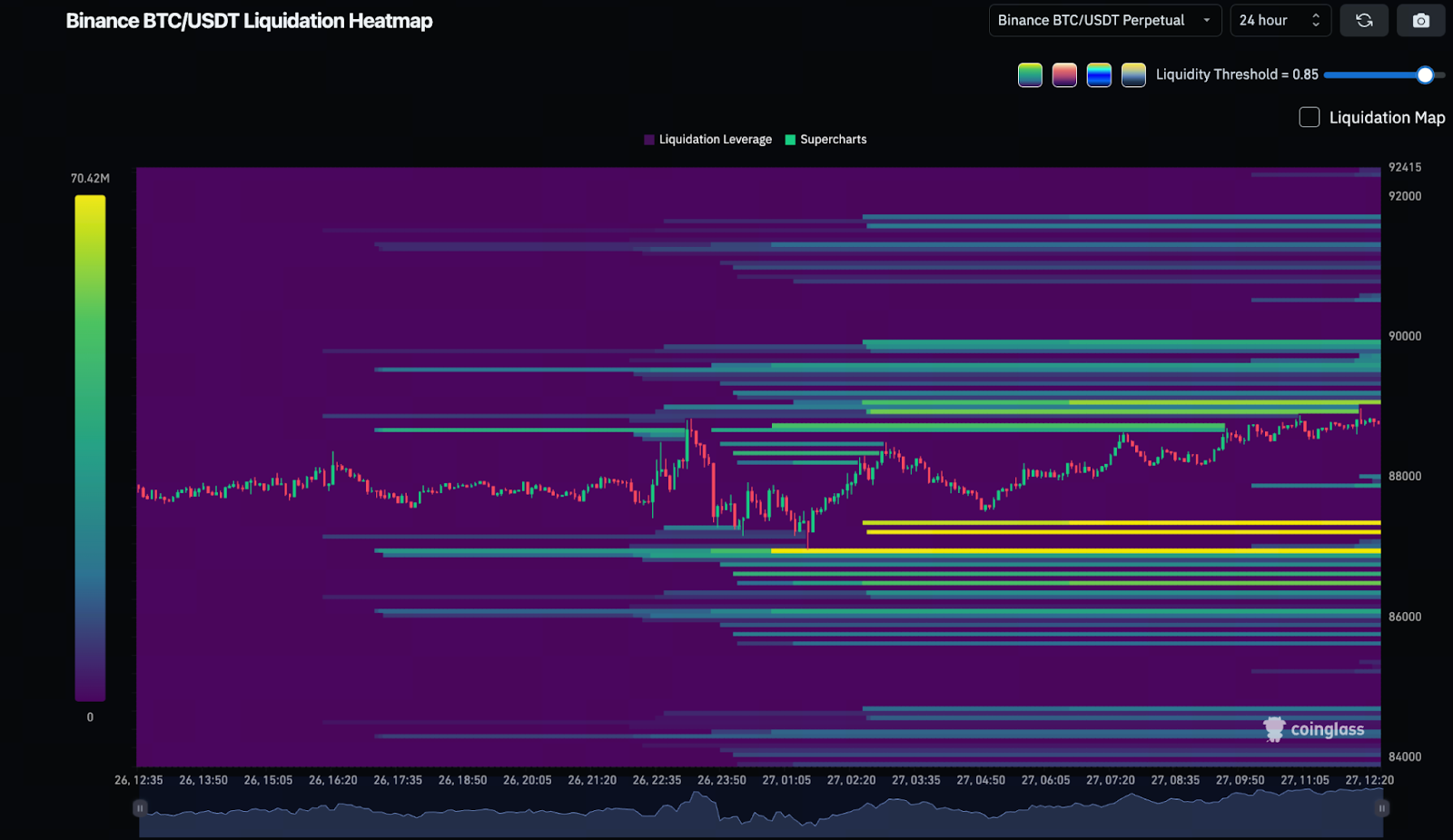
Image:
The BTC liquidation price is the threshold in leveraged Bitcoin trading at which an exchange will automatically close your position to prevent further losses. When the market price hits this critical point, the platform force-liquidates your position to cover margin shortfalls.
This mechanism is common in perpetual contracts, futures, and leveraged trades. With high leverage—such as 10x or above—the liquidation price sits very close to your entry price. If the market moves against you and reaches this level, the platform initiates liquidation.
Current Bitcoin Price and Market Conditions
-------------------------------------------
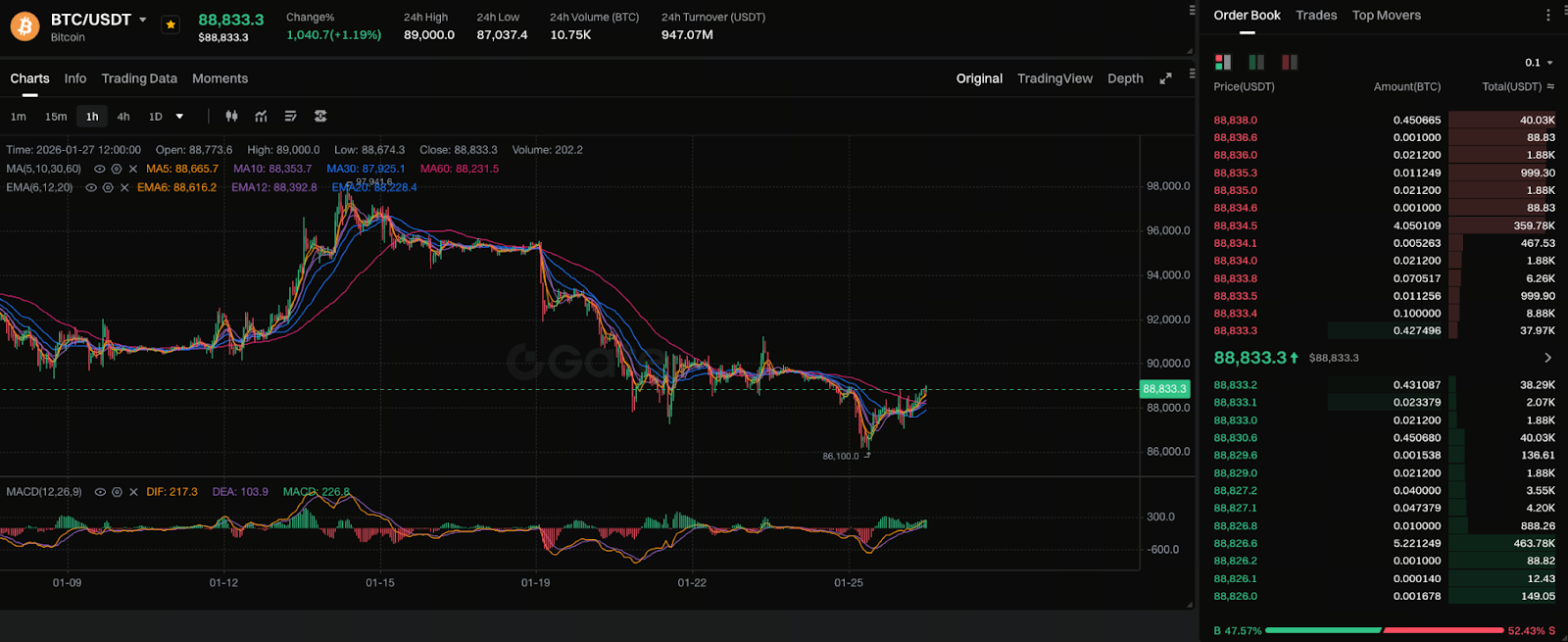
Image: [https://www.gate.com/trade/BTC\_USDT](https://www.gate.com/trade/BTC_USDT)
As of January 27, 2026, Bitcoin is trading at approximately $88,850. BTC is consolidating around $88,700, returning to a higher price range. In volatile markets, liquidation prices for leveraged traders often sit closer to spot prices, making it crucial for risk management to identify these critical levels.
How Is the Liquidation Price Calculated and What Are the Key Factors?
---------------------------------------------------------------------
The liquidation price is variable, determined by several factors:
- Entry Price
- Leverage
- Margin ratio and maintenance margin requirements
Simplified formula (for long positions): Liquidation Price ≈ Entry Price × (1 - 1/Leverage)
Example: For a 10x leveraged long position entering BTC at $30,000, the liquidation price will be near $27,000.
The principle: Higher leverage brings the liquidation price closer to the current market price. Lower leverage allows for greater price movement before liquidation is triggered.
Recent Liquidation Events and Key Zones
---------------------------------------
Recent large-scale liquidation events serve as a warning for traders:
When the market drops below specific price ranges, liquidations surge. Data shows that BTC experienced significant long liquidations after falling below $115,000, with a concentration in the $113,000–$114,000 zone.
Earlier, a steep decline to around $90,000 resulted in over $400 million in liquidations, with long positions making up the bulk—highlighting the risks of high leverage.
Historical data also reveals that lower price zones, such as $42,000–$46,000, are linked to another wave of liquidation activity.
These areas are known as liquidation concentration zones. Traders can use heatmaps and analytics tools to anticipate potential risks.
How to Mitigate Liquidation Risk?
---------------------------------
- Control leverage: Lower leverage increases the buffer between your liquidation price and the current market price.
- Monitor liquidation levels and heatmaps in real time: Tools like Coinglass and exchange depth charts reveal where liquidations cluster.
- Set stop-loss orders: Exit automatically before your position approaches the liquidation price to avoid forced liquidation.
- Diversify positions and manage capital: Avoid concentrating too much leverage on a single price level.
Summary
-------
The BTC liquidation price is a vital metric for assessing leverage risk in the market. Reviewing current prices and recent liquidation events reveals:
- Liquidation price is determined by leverage, entry price, and maintenance margin.
- Breaking below certain price ranges triggers mass liquidations and increases volatility.
- Robust risk management strategies are essential for traders.
Understanding and monitoring these liquidation metrics helps protect capital and optimize trading decisions in Bitcoin's highly volatile market.
Author: Max
* The information is not intended to be and does not constitute financial advice or any other recommendation of any sort offered or endorsed by Gate Web3.
* This article may not be reproduced, transmitted or copied without referencing Gate Web3. Contravention is an infringement of Copyright Act and may be subject to legal action.
Related Articles
Beginner
2026 Stablecoin Classification Deep Dive: From Fiat-Collateralized to Algorithmic Stablecoins, Market Landscape and Future Trends
A thorough breakdown of stablecoin types—including fiat-backed, crypto-collateralized, algorithmic, and hybrid models—paired with up-to-date regulatory and market trends, empowers readers to navigate the stablecoin ecosystem and make informed investment decisions.

Beginner
What Are Fractional NFTs? Understanding the Mechanics of NFT Fractionalization and Its Real-World Use Cases
Fractional NFTs make high-value NFTs more accessible by breaking them into tradable shares. This article offers a comprehensive overview of the underlying technology, practical use cases, and inherent limitations.
Beginner
Top Telegram Games to Watch in 2026: The New Web3 Gaming Frontier and Investment Strategies
A comprehensive review of the top Telegram games to watch in 2026—including standout projects like Notcoin, Hamster Kombat, and Azuki Alley Escape—offering expert insights into gameplay trends and potential investment opportunities.

Beginner
The Next 100x Coin? Low-Cap Crypto Gem Analysis
This article analyzes cryptocurrency projects with low market capitalization that may be noteworthy in 2025, offering analysis from the perspectives of technology, community engagement, and market potential. Additionally, the report offers guidance on coin selection and highlights key risk factors for new investors.

Beginner
What Is Jupiter? A Complete Guide to Solana’s Leading Decentralized Exchange Aggregator
Jupiter stands as the core decentralized exchange aggregator within the Solana ecosystem, delivering users the best prices, minimal slippage, and seamless cross-pool liquidity integration. This article thoroughly examines Jupiter's mechanisms, exploring its features, strengths, trading processes, and future outlook. You'll gain a clear understanding of why Jupiter has emerged as the primary entry point for trading on Solana.

Beginner
Best Metaverse Projects in 2026: Seizing the Next Digital Wave
A comprehensive analysis of the leading Metaverse projects for 2026: Explore key developments from Web2 giants like Meta and Roblox, as well as Web3 frontrunners including The Sandbox and Decentraland. This article delivers the latest trends, technological breakthroughs, and investment opportunities in the Metaverse sector.