What Is Stablecoin Velocity? How to Measure the Real Efficiency of On-Chain Capital
Stablecoin velocity is a measure of how much transfer activity stablecoins generate relative to their circulating supply over a specific period. As dollar-pegged stablecoins such as USDT and USDC have gradually become important funding tools for crypto trading, cross-border settlement, on-chain payments, and DeFi applications, market attention has shifted beyond issuance volume to whether funds are actually being used and how much economic activity each unit of stablecoin can support.
However, stablecoin movement on blockchains differs significantly from movement through traditional payment systems. The same funds may be transferred repeatedly among exchanges, wallets, liquidity pools, and cross-chain bridges, resulting in on-chain transaction volumes far exceeding the value of actual goods or services payments. Therefore, while stablecoin velocity provides a perspective on fund activity, it cannot independently determine actual payment demand. This article starts with the basic concept of velocity, analyzes the composition of on-chain transfer volume and the limitations of this metric, and explains how to more accurately evaluate the efficiency of stablecoin fund usage.
Key Takeaways
-
Stablecoin velocity measures how frequently stablecoins are transferred relative to their circulating supply over a given period. It can help assess the level of fund activity, but it does not directly represent the scale of actual payments.
-
On-chain transfer volume does not equal effective economic activity. Internal exchange transfers, arbitrage trading, cross-chain bridge operations, and bot activity can all increase stablecoin transfer volume.
-
Higher velocity does not necessarily mean greater capital efficiency. Velocity can be affected by transaction structures, market volatility, and statistical methodology, so it must be evaluated in the context of specific use cases.
-
Stablecoin supply growth and transaction demand do not always move in sync. Stablecoins can be used for payments and settlement, as well as savings, trading collateral, and on-chain liquidity reserves.
-
Evaluating the actual efficiency of stablecoin usage requires multiple metrics. Adjusted transfer volume, unique users, payment transaction volume, holding time, and application revenue can help identify more sustainable economic activity.
What Is Stablecoin Velocity, and How Does It Relate to the Velocity of Money?
Stablecoin velocity can be understood as the number of times the transferred value of a stablecoin equals its circulating supply during a given measurement period. For example, if a stablecoin has an average circulating supply of $10 billion and $50 billion in cumulative on-chain transfers during a month, its monthly velocity based on raw transfer volume would be 5x. This means that the cumulative transfer value recorded on-chain equals five times the average circulating supply. It does not mean that every stablecoin actually completed five separate payments.
This concept is somewhat related to the velocity of money in traditional economics. The velocity of money generally describes how frequently money supports economic transactions during a given period, while stablecoin velocity is estimated primarily from on-chain transfer data. Both focus on how funds move, but their statistical scopes differ. The traditional velocity of money is generally associated with transactions involving goods and services or broader economic activity, while stablecoin transfers may include financial transactions, account transfers, collateral movements, and automated operations.
Therefore, stablecoin velocity is more suitable as an indicator of on-chain fund activity than as a direct equivalent of the velocity of money in macroeconomics. To determine whether stablecoins are actually being used for payments and settlement, it is also necessary to distinguish among different types of transfers and analyze their underlying economic purposes.
How Is Stablecoin Velocity Calculated?
Stablecoin velocity is generally calculated by comparing the total stablecoin transfer volume during a specific period with the average circulating supply during the same period. For example, if a stablecoin's supply increases from $8 billion at the beginning of a month to $10 billion at the end of the month, its average supply during the period is approximately $9 billion. If total on-chain transfer volume during the month is $45 billion, the monthly velocity calculated using this methodology is approximately 5x. In practice, if daily supply data is available, calculating the period average based on daily supply is generally more accurate than simply averaging the beginning- and end-of-month figures.
The measurement period and data methodology must be standardized during the calculation. Daily, monthly, and annual velocity cannot be compared directly. In addition, simply extrapolating an unusually high volume from a single day to an entire year may overstate the level of fund activity. Stablecoins may also be issued simultaneously on different networks, such as Ethereum, Tron, and Solana. Cross-chain issuance, burning, and migration can affect supply statistics, so it is necessary to clarify whether the analysis covers a stablecoin on a single chain or the same asset aggregated across multiple networks.
More importantly, the numerator in the velocity calculation can use different transaction-volume methodologies. Raw on-chain transfer volume includes various token transfers recorded by the network, while adjusted transfer volume may attempt to exclude internal transfers, duplicate counting, or certain non-economic transactions. Different data platforms use different address-identification, filtering, and transaction-classification methods. As a result, they may produce different velocity figures even when analyzing the same stablecoin.
Why Doesn't Rising Stablecoin Transfer Volume Necessarily Mean Greater Actual Payment Demand?
Stablecoins can be used to pay for goods and services, as well as for exchange fund transfers, DeFi collateral, arbitrage trading, and cross-chain asset migration. Therefore, a stablecoin transfer on-chain does not necessarily mean that a payment has been completed in the real economy. For example, an institution may transfer 10 million USDC from one wallet to another wallet that it owns. The blockchain would record a transfer worth $10 million, but no new goods transaction would have taken place, and ownership of the funds may not have changed.
Complex smart contracts may also generate multiple token transfers during a single user operation. For example, when a user completes a stablecoin swap through an aggregator, the funds may pass through a routing contract, liquidity pool, and settlement address in sequence. If every internal transfer is included in the total, the resulting stablecoin flow may exceed the amount initially provided by the user. High-frequency trading bots and automated market-making strategies may also move the same funds repeatedly within a short period, rapidly increasing raw transfer volume.
Therefore, determining whether stablecoins have gained genuine adoption in the payment market requires distinguishing transfer volume from payment volume. The former reflects the scale of on-chain fund movements, while the latter focuses on whether funds are used for goods, services, wages, cross-border remittances, or other payment activities. The two are related but cannot be used interchangeably. High-frequency movement of stablecoins in financial markets may also serve a genuine economic function, but that function differs from everyday consumer payments.
What Is the Difference Between Raw Transfer Volume and Adjusted Transfer Volume?
Raw transfer volume generally aggregates qualifying stablecoin transfers recorded on a blockchain. It can show the overall scale of network activity, but it is vulnerable to the effects of repeated transfers, internal fund movements, and automated trading. Adjusted transfer volume attempts to reduce distortions caused by some non-organic activity through address identification, transaction classification, and statistical filtering, bringing the data closer to transfers with economic significance.
For example, stablecoin data analysis may identify known exchange addresses, cross-chain bridges, bots, and certain internal smart contract transfers. It may then adjust the statistics based on transaction direction, address activity frequency, and transfer amount. However, this adjustment does not simply remove all bot or exchange activity, because some automated transactions genuinely provide liquidity and market settlement functions. Conversely, some transfers that remain in the dataset may not represent actual payments for goods or services. Therefore, adjusted transfer volume should be understood as an estimate of economic activity processed under specific rules, rather than as a verified final payment amount.
Filtering methods may differ across platforms, and even the same platform may revise historical data as address labels and identification technologies improve. Therefore, when calculating stablecoin velocity, it is essential to specify whether raw or adjusted transfer volume is being used and to maintain a consistent methodology over time. Only by observing long-term changes under the same methodology can misinterpretations caused by changes in data definitions be reduced.
Why Doesn't Higher Velocity Necessarily Mean Greater Capital Efficiency?
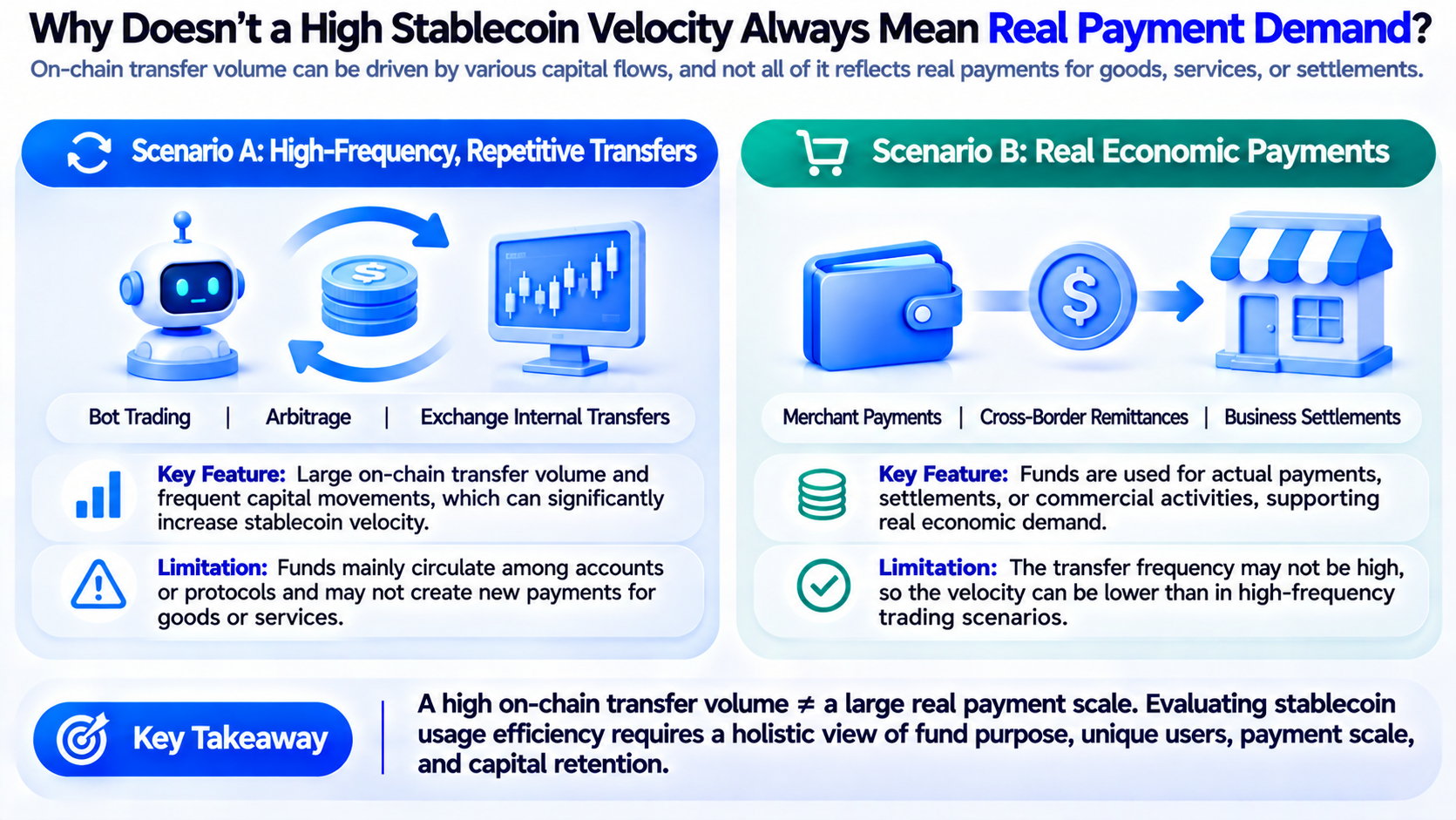
Higher velocity may mean that stablecoins are moving frequently across a network, but it may also indicate that funds are being transferred repeatedly. For example, one network may primarily use $100 million in stablecoins for corporate payments and cross-border settlement, while another may have a small number of trading bots repeatedly conduct arbitrage transactions. Even if the latter generates higher on-chain transfer volume, it cannot be concluded that it has stronger real user demand or greater payment efficiency.
In addition, velocity is affected by both the numerator and the denominator. If stablecoin supply declines while transfer volume remains unchanged, the calculated velocity will increase. If stablecoin supply grows rapidly due to increased demand for savings and fund reserves, velocity may still decline even if payment volume also increases. This means that higher velocity does not necessarily indicate improved demand, and lower velocity does not necessarily mean that a network lacks value.
Capital efficiency also requires consideration of transaction costs, settlement times, failure rates, and the length of time funds remain tied up. A cross-border payment that settles quickly at a low cost may be more efficient in practice than repeatedly moving funds among different protocols, even if it does not generate multiple on-chain transfers. Therefore, velocity is suitable for measuring the frequency of fund movement, not for directly measuring the economic value created by each unit of capital.
Why Might USDT and USDC Have Different Velocities?
USDT and USDC are both dollar-pegged stablecoins, but their usage structures may differ across networks, trading platforms, and use cases. USDT is widely used in some centralized trading and cross-border fund transfer scenarios, while USDC also plays an important role in certain DeFi, institutional settlement, and on-chain financial applications. Differences in user groups, network fees, liquidity structures, and transaction methods can all affect the transfer frequency of the two stablecoins.
For example, if a stablecoin is primarily held by users as a long-term dollar reserve, its supply may be large while its daily transfer frequency remains relatively low. Another stablecoin may be used extensively for automated trading, on-chain lending, and liquidity pool settlement. It may therefore have higher velocity even with a smaller circulating supply. However, this difference does not mean that one stablecoin necessarily has greater economic value, because the two may serve different funding functions.
When comparing USDT and USDC, the same measurement period, supply methodology, and transfer-volume adjustment method should be used. Their fund usage across different networks and applications should also be analyzed. Judging which stablecoin is more popular solely based on velocity can overlook the functional differences among stablecoins as media of exchange, payment tools, and stores of value.
How Should Stablecoin Velocity Be Analyzed Alongside Actual Payment Volume?
Determining the actual payment volume of stablecoins generally requires identifying whether funds are used for genuine payment activities rather than relying solely on on-chain transfer value. For example, a business's USDC payment to a supplier may constitute commercial settlement, while a user's USDC deposit to an exchange is closer to a transfer between financial accounts. Both may generate on-chain transactions, but their economic purposes differ. Therefore, evaluating payment adoption requires further examination of payment service provider data, merchant receipts, corporate settlement, and person-to-person transfers.
For stablecoin payment businesses, in addition to payment volume, it is important to consider the number of payments, unique payers, number of recipients, average payment size, and repeat usage rate. If growth in total payment volume primarily comes from large settlements by a small number of institutions, its commercial significance differs from that of many individual users consistently using stablecoins for everyday payments. Both models may have market value, but they should be evaluated using different metrics.
Stablecoin payments may also occur on the internal ledgers of exchanges or payment platforms, so not every payment necessarily corresponds directly to a publicly visible on-chain transfer. Conversely, a single on-chain transfer may include multiple business processes. Therefore, a more accurate approach is to combine on-chain data with business data from payment service providers, merchants, or settlement institutions to identify completed payment activities, rather than simply treating all on-chain transfers as payment volume.
Which Metrics Can Help Assess the Actual Efficiency of Stablecoin Usage?
Stablecoin velocity can serve as a starting point for observing fund activity, but a more complete analysis should cover fund size, transaction structure, user behavior, and actual economic activity. For researchers, the first step is to observe whether stablecoin supply is growing steadily and whether that growth is accompanied by increases in adjusted transfer volume and payment volume. If supply and transfer volume increase together, this may indicate that the stablecoin ecosystem is expanding. If transfer volume grows rapidly while the number of unique users remains stable, it is necessary to further analyze whether automated trading or repeated fund movements are taking place.
The sustainability of fund usage should also be considered. A network may experience high velocity during a short-term market trend or liquidity incentive program, only to see activity decline rapidly after the event ends. Compared with a single-month peak, adjusted transfer volume, user retention, payment frequency, and settlement costs sustained over multiple quarters provide a better basis for determining whether demand is stable. For corporate payments, the average settlement time, failure rate, and amount of time funds remain tied up during the settlement process are also useful metrics.
| Metric | Primary Measurement | Limitation |
|---|---|---|
| Stablecoin velocity | Frequency of fund movement relative to supply | Cannot directly identify payment purposes |
| Adjusted transfer volume | Filtered on-chain fund activity | Affected by filtering rules |
| Stablecoin supply | Fund base held and used in the market | Does not directly represent transaction activity |
| Active addresses | Number of on-chain addresses participating in transfers | One user may control multiple addresses |
| Actual payment volume | Volume of payments for goods, services, and funds | Some payments are difficult to identify directly on-chain |
| Repeat usage rate | Continued stablecoin usage by users | Requires relatively complete user-identification data |
| Settlement cost and time | Execution efficiency of payment infrastructure | Methodologies differ across networks and service providers |
| Application revenue | Commercial sustainability of payment and financial services | Does not fully represent the value of the stablecoin itself |
Taken together, these metrics can more accurately distinguish among the different functions of stablecoins as payment tools, financial transaction media, and reserve assets. Stablecoin velocity itself has no universally ideal level. What matters is whether it corresponds to the demand associated with a specific use case.
Can Stablecoin Velocity Predict Future Market Adoption?
Long-term changes in stablecoin velocity can provide a reference for market adoption, but velocity should not be treated as an independent forecasting indicator. When a stablecoin's adjusted transfer volume, active users, and payment volume continue to grow, rising velocity may reflect broader economic activity. However, if growth is primarily driven by short-term market volatility, arbitrage opportunities, or automated trading strategies, higher velocity may not be sustainable over the long term.
Market adoption is also affected by factors such as the regulatory environment, issuer credibility, redemption capabilities, trading platform support, network costs, and user experience. Even if a stablecoin has high velocity, its adoption may remain limited if it lacks stable issuance and redemption mechanisms or cannot connect effectively with bank accounts and merchant payment systems. Conversely, some stablecoins may maintain low velocity because of institutional fund management or long-term reserve demand, but that does not mean they lack practical utility.
Therefore, velocity is more suitable for explaining fund activity that has already occurred than for directly forecasting future growth. Researchers seeking to evaluate the long-term development potential of stablecoins can combine velocity trends with payment infrastructure development, user retention, and changes in fund usage to determine whether stablecoins are expanding from crypto trading media into broader financial and payment tools.
Conclusion
Stablecoin velocity is an important metric for observing the frequency of on-chain fund movement and understanding the relationship between stablecoin supply and transaction activity. However, because stablecoins are widely used for trading, payments, lending, and fund transfers, on-chain transfer volume does not equal actual payment volume, and higher velocity does not necessarily mean greater capital efficiency.
Evaluating the practical value of stablecoins requires combining velocity with metrics such as adjusted transfer volume, actual payment volume, user retention, settlement costs, and application revenue. Only by clarifying why funds move, who uses them, and whether they generate sustained economic activity can the efficiency of stablecoins in on-chain finance and real-world payment systems be assessed more accurately.
FAQ
Is Higher Stablecoin Velocity Always Better?
Not necessarily. Higher velocity may indicate active fund usage, but it may also be driven by bot activity, arbitrage, and repeated transfers. It should be evaluated together with actual payment volume and fund usage.
What Is the Difference Between Stablecoin Velocity and Transaction Volume?
Transaction volume reflects the value of transfers that occur during a given period. Velocity compares this value with the circulating supply of stablecoins to assess the frequency of fund movement relative to the supply base.
Why Might Stablecoin Velocity Decline Even When Supply Increases?
If stablecoin supply grows faster than transfer volume, velocity may decline. This may be related to fund reserves, long-term holding, or liquidity accumulation.
Can the Velocities of USDT and USDC Be Compared Directly?
They can be compared using a consistent measurement period and data methodology, but differences in their usage across trading, payments, DeFi, and fund reserves must also be considered.
Does Adjusted Transfer Volume Equal Actual Payment Volume?
No. Adjusted transfer volume attempts to reduce certain repeated or non-organic transactions, but it may still include investment, trading, and other financial activities. Actual payment volume requires further identification of fund usage.
Which Data Is Most Useful for Determining Whether Stablecoins Have Achieved Genuine Adoption?
A combination of adjusted transfer volume, payment volume, unique users, repeat usage rate, stablecoin supply, and settlement costs can be analyzed, with a focus on long-term changes in these metrics.
Related Articles

What is USDC? A Complete Guide to One of the Most Trusted Stablecoins

What Is a Token? Understanding the Foundation of the Web3 Economy

What Is Stablechain? Understanding the Blockchain Infrastructure Built for Stablecoin Payments

Why Are Banks Issuing Stablecoins? From USBDC to the Next Generation of Bank Payments

What Are AI Agent Payments? Understanding How AI Agents Execute Autonomous Payments