

Search Token/Wallet
What Is an AI Agent Session Key? How Account Abstraction Enables Secure Automated On-Chain Transactions
Beginner
AIAn AI Agent Session Key is an authorization mechanism designed for smart accounts and automated applications. It allows users to configure restricted signing permissions for an AI Agent so that it can execute on-chain transactions under specified conditions without directly holding the master private key of the user's wallet. Unlike traditional wallets, which require the user to sign every transaction, a Session Key can temporarily delegate part of the execution authority to a software agent while using smart account validation rules to limit its scope of operations.
As AI Agents evolve from information retrieval and content generation to automated task execution, on-chain interactions face new identity and authorization challenges. An agent that automatically manages DeFi positions, executes recurring swaps, or pays for services needs the ability to continuously initiate transactions. However, if it receives the wallet's master private key directly, it may gain control over more assets than the task requires. Establishing a balance between automation efficiency and asset security has therefore become an important challenge in the convergence of AI and Web3.
Account Abstraction, smart accounts, and Session Keys provide a programmable technical path toward solving this problem. Through Account Abstraction infrastructure such as ERC-4337 and validation modules that support fine-grained permission controls, users can separate account ownership from day-to-day transaction execution authority. Understanding how Session Keys work requires further analysis of how they differ from traditional private keys, their authorization and validation processes, their practical use cases, and the security boundaries that still exist in automated trading.
## Key Points
- A Session Key is a temporary signing mechanism with limited permissions. Users can grant an AI Agent execution authority within specified limits for time, transaction amounts, contract addresses, and operation types without handing over the wallet's master private key.
- Account Abstraction is an important foundation for flexible authorization. Smart accounts can use programmable validation logic to determine whether operations submitted by an AI Agent comply with preset permissions.
- ERC-4337 provides smart accounts with a transaction execution framework that does not require changes to Ethereum's underlying consensus protocol. However, ERC-4337 itself does not directly define a complete Session Key permission model. Specific functionality still depends on the wallet and permission module implementation.
- Session Keys can reduce the interaction costs of frequent on-chain operations. Within the scope pre-authorized by the user, an AI Agent can execute token swaps, recurring payments, position management, and other automated tasks without requesting a signature from the master wallet each time.
- Temporary keys do not guarantee absolute security. If the authorization scope is too broad, a contract contains vulnerabilities, or the key is compromised, an attacker may still execute malicious operations within the valid permission scope.
- Secure execution by an AI Agent requires multiple mechanisms working together. In addition to Session Keys, it also requires transaction simulation, permission validation, spending controls, revocation mechanisms, and management of external protocol risks.
## What Is an AI Agent Session Key? How Does It Differ from a Regular Wallet Private Key?
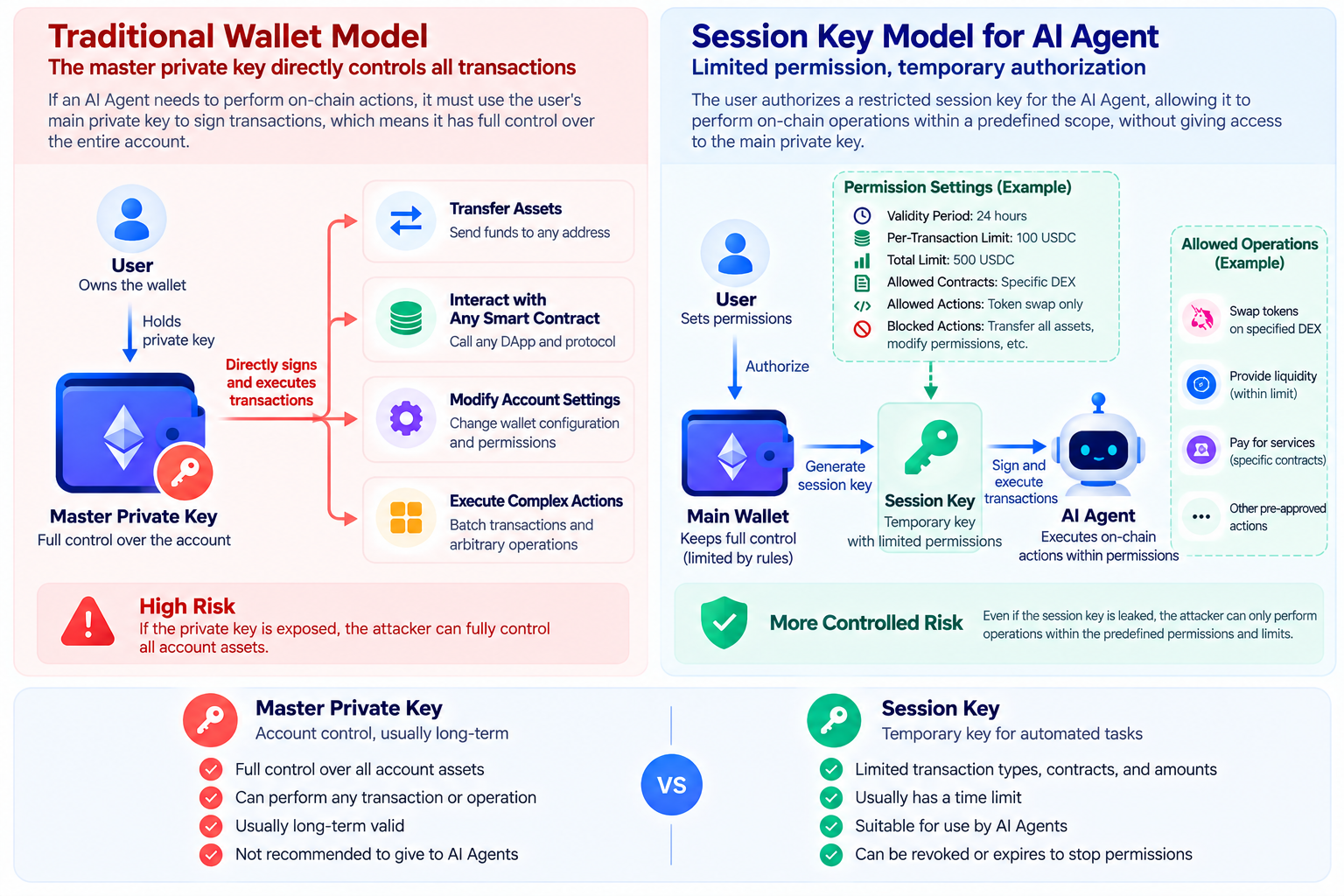
A Session Key is a temporary authorization key with restricted permissions, typically used with smart accounts, on-chain games, and automated applications. Its basic approach is to separate the account's core control authority from its day-to-day execution authority: The user continues to manage assets and authorization rules through the master wallet, while the AI Agent uses an independent Session Key to sign transactions or perform specific operations within the permitted scope.
Traditional Externally Owned Accounts (EOAs) are generally controlled directly by a private key. Anyone with a valid private key can initiate transactions according to the assets held by the account and the rules of the relevant protocols. For an AI Agent that needs to run continuously, giving the master private key directly to a model or automated program could expose the entire account to risk if the operating environment is compromised, the key is leaked, or the operating logic is exploited.
Session Keys reduce this risk by limiting the authorization scope. Users can set the Session Key's validity period, the contracts it can call, the functions it can execute, the limit per transaction, or the cumulative spending limit. Before executing an operation, the smart account checks the signature and related rules. Only transactions that meet the conditions can pass validation. It is important to note that these restrictions are not inherently available in every Session Key implementation. The relevant account contract or permission module must support and enforce them.
| Comparison | Wallet Master Private Key | Session Key |
| --- | --- | --- |
| Primary use | Account control, core authorization, and asset management | Temporary authorization and automated operations |
| Permission scope | Typically has core control over the account | Can be limited by transaction type, contract, and amount |
| Validity period | Typically long-term | Can have an expiration time |
| Transaction approval | Signed directly by the master key | Signed by the Session Key after authorization |
| Suitable for giving to an AI Agent | Not recommended | Can be used in a controlled environment |
| Consequences of key compromise | May put the entire account at risk | The loss depends on the actual execution limits |
| Permission revocation | Usually involves key or account control mechanisms | Can be terminated through expiration or explicit revocation |
Therefore, a Session Key is not a new type of wallet that completely replaces the master private key. Instead, it extends the way account authorization works. Its security value comes from permission separation and verifiable restrictions, not from any special cryptographic capabilities of the key itself.
## How Does Account Abstraction Support Session Keys?
Account Abstraction (AA) is a technical design that makes account validation and transaction execution logic more flexible. Traditional EOAs primarily rely on the signature validation method defined by the protocol, while Smart Accounts use smart contracts to manage account permissions and can support multisignature authorization, recovery mechanisms, transaction batching, and custom authorization.
The connection between Session Keys and Account Abstraction is that smart accounts can use programmatic rules to determine whether a transaction has been authorized. For example, a user can create a Session Key for an AI Agent that is valid for 24 hours and allow it to call only specific transaction functions on a designated DEX. When the AI Agent submits a transaction, the smart account must verify whether the Session Key signature is valid, whether the authorization has expired, and whether the transaction target and parameters comply with the rules.
This mechanism separates account ownership from transaction execution authority. Users can retain the ability to modify permissions, revoke authorization, and manage core assets while allowing the AI Agent to perform specific routine tasks. However, Account Abstraction itself does not automatically guarantee transaction security. Security ultimately depends on the correctness of the smart account code, permission modules, and their configuration.
For AI Agents, the significance of Account Abstraction is not limited to reducing wallet pop-ups. It also establishes authorization boundaries that can be enforced by smart contracts. The AI model proposes an action, while the smart account determines whether the action complies with the permissions preset by the user. Each serves a different role.
## What Is ERC-4337? How Do Session Keys Execute Transactions Through Smart Accounts?
ERC-4337 is an important Ethereum Account Abstraction standard. Through components such as UserOperation, Bundler, and EntryPoint, it provides smart accounts with a transaction validation and execution framework without requiring changes to Ethereum's underlying consensus rules.
Under the traditional transaction model, an EOA signs and sends a transaction directly. ERC-4337 allows smart accounts to process user operations using custom validation logic. After a user or application creates a UserOperation, it can submit the operation to a Bundler. The Bundler packages one or more operations into an on-chain transaction and triggers validation and execution through the EntryPoint contract.
Its core components include:
| Component | Primary Function |
| --- | --- |
| Smart Account | Holds assets and manages validation logic and transaction execution |
| UserOperation | Describes the account operation the user wants to execute |
| Bundler | Collects UserOperations and submits on-chain transactions |
| EntryPoint | Coordinates account validation, Gas settlement, and execution |
| Paymaster | Provides Gas payment support for transactions when conditions are met |
| Session Key Module | Validates temporary keys and permission restrictions according to the specific implementation |
In a smart account that supports Session Keys, an AI Agent can use a Session Key to sign a UserOperation. The validation logic then checks the signature and authorization conditions. If the requirements are met, the transaction proceeds to execution. If the transaction exceeds its limit, calls an unauthorized contract, or uses an expired authorization, the validation module should reject the operation.
It is important to distinguish between two concepts: ERC-4337 provides the foundational execution framework for smart account transactions, but it does not natively define a complete Session Key permission model. Session Keys are generally implemented through a wallet's own validation logic or extension modules. Modular account solutions such as ERC-7579 and ERC-6900 can provide a technical foundation for integrating permission modules, but the level of support depends on the wallet implementation.
## How Does an AI Agent Use a Session Key to Complete an Automated On-Chain Transaction?
Consider an AI Agent that automatically manages DeFi assets. Suppose a user wants the agent to execute small USDC-to-ETH swaps within the next 24 hours based on preset conditions. The user does not want to sign every transaction manually or give the wallet's master private key to the agent, so they can choose a smart account that supports Session Keys.
The complete process usually includes the following steps.
**Step 1: The user creates an authorization.** The user signs or submits an authorization configuration through the master wallet, specifying the Session Key public key to be used by the AI Agent and setting the validity period, permitted contracts, transaction functions, and fund limits.
**Step 2: The smart account records or validates the authorization.** Depending on the wallet architecture, authorization information may be stored on-chain or used together with a signed authorization credential and on-chain validation logic. Regardless of the approach, the authenticity and valid scope of the authorization must be verifiable when the transaction is executed.
**Step 3: The AI Agent determines whether to execute the transaction.** The agent generates an operation instruction based on the strategy, market data, or other conditions set by the user. For example, it may initiate a swap of no more than 100 USDC when a preset condition is met.
**Step 4: The AI Agent signs with the Session Key.** In a controlled signing environment, the AI Agent uses the Session Key to sign the operation and submits it through the relevant transaction infrastructure. An implementation based on ERC-4337 can complete this process through a UserOperation and Bundler.
**Step 5: Validation and execution.** The smart account checks the Session Key, authorization period, transaction target, and amount limits. If all conditions are met, the operation can proceed. If it violates the rules, the transaction should be rejected.
**Step 6: Authorization expiration or revocation.** After the session ends, the key should lose the corresponding permissions. The user can also terminate the authorization early through a revocation mechanism supported by the wallet. However, whether revocation takes effect immediately and whether it requires an on-chain transaction depends on the specific implementation.
### Session Key Authorization Example
The following is a hypothetical permission configuration intended to illustrate how to limit an AI Agent's transaction capabilities. It does not mean that a particular wallet already supports all of these parameters.
| Authorization Condition | Example |
| --- | --- |
| Validity period | 24 hours |
| Permitted asset | USDC |
| Permitted operation | Swap USDC for ETH |
| Per-transaction limit | 100 USDC |
| Cumulative limit | 500 USDC |
| Target contract | A designated and verified DEX contract |
| Prohibited operations | Transferring other assets, modifying account permissions, upgrading account modules |
| Revocation method | Revoke the Session Key authorization through the master wallet |
It is important to note that restricting the transaction contract address may not be sufficient. Some contracts support complex routing or arbitrary external calls. If a permission module checks only the target address without validating the function selector, transaction parameters, and actual asset flow, the AI Agent may still execute high-risk operations within an authorization scope that appears legitimate.
## What Is the Relationship Between ERC-4337, ERC-7579, ERC-7715, and Session Keys?
Session Keys are not a unified standard defined solely by ERC-4337. Multiple Account Abstraction and permission management standards in the Ethereum ecosystem address transaction execution, account modularity, and application authorization separately.
ERC-4337 primarily addresses how smart accounts submit, validate, and execute user operations. It allows accounts to use custom validation logic but does not specify which Session Key solution all wallets must adopt.
ERC-7579 focuses on modular smart account interfaces, allowing accounts to extend their validation and execution capabilities through different types of modules. Wallets that support the relevant architecture can integrate Session Key validation modules, but the standard itself does not mean that all wallets support the same permission configurations.
ERC-6900 also targets modular smart accounts and emphasizes plugins and permission management mechanisms. It can provide a structured extension method for complex account functionality, but compatibility differences may still exist between implementations.
ERC-7715 focuses on how applications request execution permissions from wallets. Its design allows DApps to request authorization for specific operations together with rules such as expiration periods, thereby supporting subsequent transactions without requiring manual confirmation each time. As of October 2026, ERC-7715 remains a draft. Its interface design should not be understood as a unified implementation already adopted by all wallets.
The relationship among these standards can be understood as follows: ERC-4337 provides the foundation for transaction execution, modular account standards help extend account functionality, permission request standards improve authorization interactions between applications and wallets, and Session Keys are a usage pattern built on specific account and authorization implementations.
## What On-Chain Automation Scenarios Can Session Keys Enable for AI Agents?
The primary value of Session Keys is that they allow applications that need to perform operations continuously to avoid relying on manual user signatures for every transaction. For AI Agents, this capability can support multiple on-chain use cases, provided that the wallet has the corresponding permission controls and the automation strategy has been properly validated.
In **DeFi position management**, an AI Agent can monitor asset ratios, lending health factors, or liquidity changes based on preset conditions and execute rebalancing operations within the authorized scope. For example, a user can allow the agent to adjust a limited amount of assets within a specific protocol while preventing it from transferring funds to unknown addresses. However, the agent may still incur trading losses due to market volatility, oracle issues, or strategy errors.
In **recurring on-chain payments**, Session Keys can support automatic subscription payments, purchases of data services, or calls to specific APIs. For agents that need to run continuously, usage-based settlement may be more convenient than requiring manual authorization for every payment. These applications must clearly define the payment recipient, payment period, and cumulative amount to prevent abnormal calls from causing continuous charges.
In **on-chain games and digital asset interactions**, players can authorize applications to perform low-risk, high-frequency operations without triggering a wallet confirmation window every time. For game characters controlled by AI Agents, Session Keys can also restrict the game contracts that may be called and the assets that may be used.
In **AI Agent collaboration networks**, different agents may need to purchase data, call external services, or exchange computing resources. Restricted authorization can allow agents to make payments within a certain limit. However, building a reliable machine-to-machine transaction network also requires service verification, identity management, and dispute resolution mechanisms.
## How Do Session Keys Differ from ERC-20 Token Approval?
Session Keys and ERC-20 Token Approvals both involve authorization, but they control different objects and permission scopes.
An ERC-20 Token Approval generally allows a designated Spender address to call `transferFrom` to transfer tokens within an approved amount. It primarily manages the spending authority for a particular token rather than authorizing an agent to perform complete account operations on behalf of the user.
A Session Key can be used to sign smart account operations and, in supported implementations, restrict the target contract, function, validity period, and other conditions. Its control scope may be more flexible than that of a single-token authorization, but this also means that the permission module must correctly validate more transaction parameters.
| Comparison | ERC-20 Token Approval | Session Key |
| --- | --- | --- |
| Primary function | Authorizes a designated address to use a token allowance | Authorizes a temporary signer to execute restricted operations |
| Controlled object | Spending authority for a specific token | Smart account operation permissions |
| Time restriction | The ERC-20 standard itself does not provide a universal expiration mechanism | Can be set through a specific implementation |
| Contract and function restrictions | Primarily depends on the Spender and its contract logic | Can be restricted through a permission module |
| Typical use cases | Token use by DEXs and lending protocols | AI Agents, automated tasks, and on-chain games |
| Primary risks | Excessive allowance and malicious Spender | Excessive permissions, key compromise, and validation vulnerabilities |
It is particularly important to note that a Session Key's spending limits may not cover Token Approvals previously granted by the account to third-party contracts. If an AI Agent is allowed to call a contract with complex execution capabilities, it is still necessary to check whether that contract can use existing approvals to transfer assets. Therefore, a secure automated account should manage both Session Key permissions and token authorization risks.
## Are Session Keys Really Secure? What Risks Exist in Automated Trading by AI Agents?
Session Keys can limit an AI Agent's permissions, but they cannot guarantee that on-chain automated trading will be completely secure. Security depends on key management, authorization scope, smart account validation logic, and the reliability of external protocols. If any of these areas fails, assets may be lost even if the user has not disclosed the master private key.
1. **Authorization scope is too broad.** If the user allows the AI Agent to call a large number of contracts or use a high spending limit for an extended period, an attacker who obtains the Session Key may use those permissions to execute malicious transactions. In particular, when arbitrary contract calls or complex batch transactions are allowed, a simple spending limit may not be sufficient to prevent funds from being transferred.
2. **Smart account and permission module vulnerabilities.** If the validation module does not correctly check transaction parameters, authorization status, or cumulative limits, it may allow operations beyond what was intended. For example, if the system limits the amount of each transaction but does not reliably record cumulative spending, an attacker may consume more assets through repeated transactions.
3. **AI Agent decision-making risks.** The agent may be affected by inaccurate data, malicious web content, or prompt injection attacks and generate transactions that do not reflect the user's actual intent. A Session Key can prevent operations beyond the permission scope, but it may not prevent erroneous transactions within the authorized scope. An agent authorized to use 500 USDC could still lose that 500 USDC because of a poor decision.
4. **Key storage and operating environment risks.** If the Session Key private key is stored in plaintext on a server, in logs, or in an insecure application environment, it may be stolen. Even if the authorization period is short, an attacker may use the entire allowance quickly during the valid period. In actual deployments, secure key storage, access controls, log management, and anomaly detection should be used to reduce risk.
Therefore, Session Keys should be viewed as risk-limitation tools rather than complete security solutions for automated trading.
## How Can You Design More Secure Session Key Permissions for an AI Agent?
The core principle when designing Session Key permissions is the **Principle of Least Privilege**: Grant only the operational capabilities required to complete the task, shorten the validity period as much as possible, limit the amount of funds, and reduce the number of external contracts that can be called.
For a simple recurring swap task, users can restrict the asset types, target protocol, transaction functions, per-transaction amount, and cumulative limit. They should not directly allow the agent to make arbitrary contract calls. For tasks involving lending or liquidity management, users must also consider transaction failures, price slippage, liquidation risk, and the additional impact of complex contract calls.
In addition to permission configuration, simulation and checks before transaction execution are also important. Before submitting an operation, the system can evaluate the expected asset changes, transaction costs, and call path and intercept abnormal results. It is important to note that transaction simulation reflects expected results under a specific state and cannot guarantee that the actual result will be exactly the same when the transaction is executed in a block.
Users should also be able to view currently active Session Key authorizations and revoke them promptly if they detect abnormal activity. For AI Agents that need to run for an extended period, users can adopt short authorization periods, increase limits in stages, and require periodic reauthorization to avoid granting excessive permissions all at once.
From a system architecture perspective, the AI Agent's task planning, transaction construction, and key signing should be appropriately isolated. The model can propose an operation, but its output should not bypass permission validation on its own. Final control over fund operations should be provided by independent signing and strategy validation mechanisms so that automation remains subject to clearly defined security boundaries.
## How Do Session Keys Help AI Agents Evolve from Information Tools to On-Chain Execution?
Many AI Agents currently focus on information retrieval, data analysis, and task planning. Their output generally still requires the user to confirm and execute actions manually. The combination of Session Keys and Account Abstraction allows some tasks to move beyond generating recommendations and extend into actual on-chain operations, reducing the distance between decision-making and execution.
For example, an AI Agent analyzing the DeFi market can first identify that an asset allocation has deviated from its target and then construct a transaction based on a preset strategy. If the user has already granted the relevant permissions through a Session Key, the agent can submit the operation without repeatedly requesting a signature from the master wallet. For tasks that need to run continuously, this mechanism can reduce manual intervention but also requires more reliable monitoring and anomaly handling.
From a broader technology development perspective, Session Keys are also one of the important authorization components enabling AI Agents to participate in the machine economy. When agents can call external services, purchase computing resources, and make payments, users need a mechanism that gives agents the ability to act while limiting their access to funds. Programmable accounts and temporary authorization provide a viable technical foundation for this.
However, Session Keys primarily address **who is authorized to perform which operation**, not **whether an operation is worth performing**. An AI Agent's economic judgment, the reliability of external information, and the risks of its trading strategy still require independent control mechanisms. For AI Agents to become reliable on-chain execution participants, account security, agent reliability, and application protocol security must develop together.
## Summary
An AI Agent Session Key is a technical mechanism that separates a smart account's core control authority from automated transaction execution authority through temporary keys and programmable authorization rules. It allows users to grant an AI Agent execution permissions within defined limits for time, specific contracts, operation types, and fund amounts without exposing the master private key.
Account Abstraction provides an important technical foundation for Session Keys. ERC-4337 allows smart accounts to process on-chain operations using custom validation logic. Modular account solutions such as ERC-7579 and ERC-6900 can help extend permission management capabilities, while ERC-7715 explores a more standardized approach to requesting execution permissions between applications and wallets. Together, these mechanisms are helping Web3 wallets evolve from simple asset-signing tools into account systems with programmable authorization capabilities.
For AI Agents, the significance of Session Keys goes beyond reducing the number of transaction confirmations. They allow agents to perform on-chain tasks within clearly defined permission boundaries. As DeFi automation, on-chain payments, and machine-to-machine transactions develop, this capability may become important infrastructure connecting AI and Web3.
However, Session Keys cannot eliminate risks such as smart contract vulnerabilities, key compromise, or AI decision-making errors. Only by combining least-privilege permissions, spending limits, transaction validation, and revocable authorization can users improve automation efficiency while more effectively controlling asset risks.
## FAQ
### What Is an AI Agent Session Key?
A Session Key is a temporary signing key with restricted permissions. It allows an AI Agent to execute on-chain transactions within the time, amount, and operation limits pre-authorized by the user without obtaining the wallet's master private key.
### How Does a Session Key Differ from a Wallet Private Key?
A wallet's master private key typically has core control over the account, while a Session Key may have only partial, temporary execution permissions. The primary difference is the authorization scope, not necessarily the underlying cryptographic algorithm.
### Must Session Keys Use ERC-4337?
Not necessarily. Session Keys can be implemented through different smart account or delegated authorization architectures. ERC-4337 is a common Account Abstraction execution framework, but not all Session Keys must depend on it.
### Does ERC-4337 Natively Support Session Keys?
ERC-4337 allows smart accounts to use custom validation logic, but it does not directly define a unified Session Key permission model. Specific functionality is generally implemented by wallets, validation modules, or other authorization mechanisms.
### Can Session Keys Limit an AI Agent's Transaction Amount?
Yes, but the wallet and permission module must support and correctly enforce spending-limit checks. Per-transaction limits, cumulative limits, and asset-type restrictions are not default features of every Session Key solution.
### Are Wallet Funds Still Safe if a Session Key Is Compromised?
Not necessarily. An attacker may use the Session Key to execute permitted operations during the authorization period. Limiting the amount of funds, shortening the validity period, and promptly revoking the authorization can reduce potential losses but cannot guarantee zero risk.
### Can Session Keys Be Used for Automated DeFi Trading?
Yes. A smart account with the relevant capabilities can authorize an AI Agent to execute swaps, rebalancing, or other operations within specified protocols and spending limits. However, trading strategies, price slippage, and protocol vulnerabilities may still result in losses.
### What Is the Relationship Between Session Keys and ERC-7715?
ERC-7715 is a draft standard for requesting execution permissions from wallets. It allows applications to request restricted authorization from wallets. It is related to the use cases of Session Keys but is not equivalent to a unified Session Key implementation that all wallets must adopt.
Author: Learn Team
* The information is not intended to be and does not constitute financial advice or any other recommendation of any sort offered or endorsed by Gate Web3.
* This article may not be reproduced, transmitted or copied without referencing Gate Web3. Contravention is an infringement of Copyright Act and may be subject to legal action.
Related Articles

Beginner
What Is ERC-8183? Exploring the AI Agent Commercial Standard and the Infrastructure of the Decentralized Agent Economy
ERC-8183 is an Agent Commerce standard developed by the Virtuals Protocol and the Ethereum dAI team. By leveraging on-chain escrow, task lifecycle management, and evaluation mechanisms, it facilitates reliable transactions between AI Agents and establishes core infrastructure for the decentralized AI economy.

Beginner
AI Agents Becoming Economic Actors: What Infrastructure Gaps Can Blockchain Fill?
a16z crypto has recently explored how blockchain technology underpins AI Agents across five key dimensions: identity, governance, payments, trust, and control. This article objectively outlines their arguments and offers a concise assessment of the scope of applicability and engineering realities, serving as a reference for technology and product decision-makers.

Beginner
Anthropic vs. OpenAI: Revenue, Compute Capacity, and Business Models Compared
Anthropic and OpenAI are both technology companies specializing in large language models and generative AI. Anthropic is known for its Claude family of models and its vision of “interpretable, controllable AI,” while OpenAI has become a leading gateway to the generative AI market through its GPT family, ChatGPT, and expansive developer ecosystem.

Beginner
What Is RoboForce? An In-Depth Analysis of the Technical Path and Industrial Prospects of an AI Robotic Workforce Platform
RoboForce is an emerging company specializing in AI-driven robotic workforce systems, leveraging high-precision robotics and automation technologies to replace dangerous and repetitive tasks. This article offers an in-depth examination of RoboForce's technical architecture, practical applications, and prospects within the industry.

Beginner
Talus Network: Building a Decentralized Layer 1 Ecosystem for AI Agents
Talus Network is a Layer 1 blockchain focused on AI agents, designed to deliver a verifiable, scalable, and cross-chain capable decentralized intelligent agent platform by leveraging Move VM, Cosmos SDK, and IBC technologies. This article presents a thorough analysis of Talus, detailing its funding background, core architecture, AI technology stack, Mirror Objects mechanism, and TAI token applications, to help you understand Talus's unique positioning and potential in the ongoing integration of AI and Web3.

Beginner
How to Reduce Token Costs in the AI Era: Practical Strategies from Prompt Optimization to Model Selection
This article provides a comprehensive analysis of key strategies for minimizing Token costs in the AI era, including prompt optimization, context compression, output control, image and PDF processing, caching strategies, and model task allocation. These methods enable individuals and teams to reduce AI usage expenses without compromising performance.