

Search Token/Wallet
L2 Is No Longer the Star: Ethereum Rewrites Itself as a Multi-Layer Operating Syste
## L2 Hasn't Disappeared—The Narrative Has Just Ended
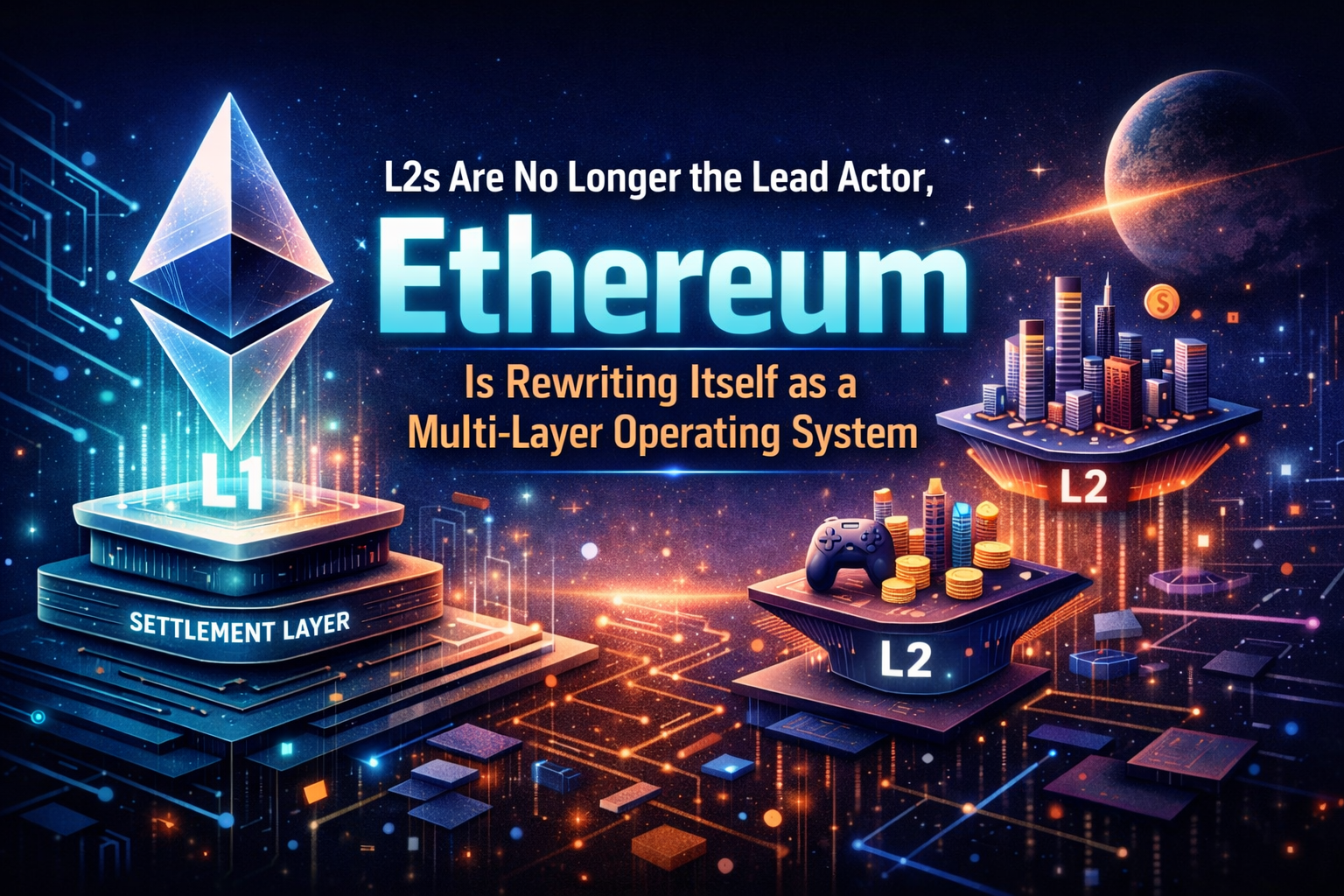
Over the past year, sentiment toward L2 has shifted from intense enthusiasm to a more measured calm. Yet, in light of Ethereum’s latest developments, this shift is best understood as the narrative winding down—not a loss of value.
The story of L2 can be summed up simply: it has moved from hype-driven storytelling to a results-oriented phase. The current market reality is:
- The launch of new L2 projects has slowed significantly, with less momentum from fundraising and airdrops.
- User growth is tapering off, and leading L2s are now competing for existing user traffic.
- Capital is no longer chasing “conceptual scaling”; instead, it’s focusing on real-world use cases.
This marks a transition for L2s from “beta assets” (driven by narrative) to “alpha assets” (driven by real competitive strength). The latest statements from the Ethereum Foundation, at their core, give this stage a clear definition.
## Ethereum Is Deliberately Narrowing L1’s Scope
The Ethereum Foundation’s core philosophy can be summarized as: L1 will no longer try to do everything, but will focus on three essential functions—security, settlement, and liquidity.
This is a deliberate contraction, but it’s not a sign of weakness—it’s a move toward greater strength. No global-scale system can handle every task on a single layer. The core responsibilities of L1 are now being clarified as:
- Global settlement layer: the final confirmation point for all assets
- Liquidity hub: the foundation for DeFi and core capital accumulation
- Trust anchor: providing censorship resistance and security assurances
In other words, Ethereum is no longer trying to win the “execution layer race,” but is positioning itself as the foundational infrastructure for the entire ecosystem.
## The Real Role of L2: Not Just a Scaling Solution, but an “Economic Zone”
In this new framework, L2 is being redefined as an “autonomous on-chain economic zone,” not just a scaling solution. This distinction is crucial, as it explains the increasing differentiation among L2s.
Competition among L2s has shifted from TPS to more complex dimensions:
- Do they offer unique application scenarios (games, AI, finance, etc.)?
- Do they have their own user base and community culture?
- Can they establish a sustainable revenue model?
- Are they differentiated in privacy, compliance, or performance?
The core capability of L2 is now about building an “independent yet connected” mini-ecosystem on top of Ethereum.
This is why many L2s seem to have “gone quiet”—not because the sector has failed, but because they haven’t found their unique positioning.
## ETH’s Value Logic Is Undergoing Its Most Pivotal Shift
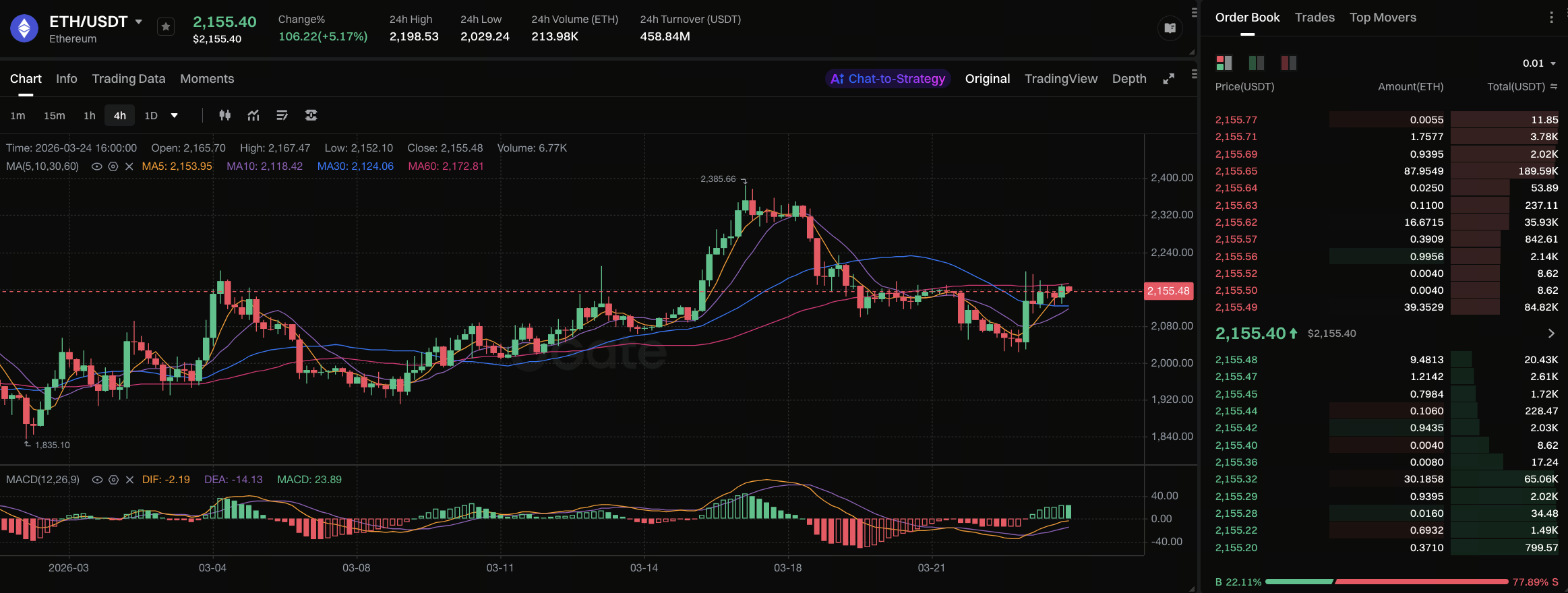
Image source: [Gate Market Page](https://www.gate.com/trade/ETH_USDT)
One of the market’s biggest misconceptions is still valuing ETH by outdated logic. Previously, ETH’s value proposition was “more on-chain activity → more gas fees → higher ETH value.” Now that L2s handle execution, this logic no longer holds.
The new value pathway is more like a “systemic cycle”:
- L2s bring in users and applications
- Activity creates asset accumulation and liquidity demand
- Core value flows back to L1
- ETH becomes the settlement asset and collateral core
In this structure, ETH’s role fundamentally changes:
- It’s no longer just “fuel”—it’s the foundational asset
- It’s used not only for payments, but as the backbone of trust and liquidity
- The value source shifts from “usage fees” to “system-level demand”
This also explains why, in the short term, ETH may underperform Bitcoin: Bitcoin’s narrative is simpler, while ETH’s new logic will take time for the market to fully digest.
## The L2 Cooldown Clarifies ETH’s Long-Term Value Proposition
From an investment perspective, the cooling of L2 is actually a positive development. During periods of hype, the market focuses on short-term returns and overlooks the underlying structure. As the hype fades, the real value pathway comes into focus.
Current trends include:
- Leading L2s are building their own “moats”
- Liquidity is concentrating in safer, more mature layers
- Ethereum L1’s settlement and capital attributes are being reinforced
This signals a shift in the market from “L2 speculation” to “repricing the entire Ethereum system.”
## Price Outlook: For ETH, the Key Is Not L2, But Whether the System Forms a Closed Loop
Looking at ETH’s price potential in the current structure, the key variable is no longer whether any single L2 succeeds, but whether the entire system forms a closed loop.
Consider three scenarios:
- **Pessimistic:** L2s remain fragmented, liquidity fails to return, and ETH stays weak ($2,000–$3,000)
- **Neutral:** L2s develop steadily, cross-chain experiences improve, and ETH gradually recovers in value ($3,500–$5,500)
- **Optimistic:** Strong interoperability and unified liquidity make ETH the true “on-chain settlement asset,” with prices potentially breaking above $7,000
The most critical factors are not technical, but:
- Will liquidity flow back to L1?
- Will users be shielded from “multi-chain complexity”?
- Will applications continue to grow on L2s?
## Conclusion: Ethereum’s Endgame Is Not Just About Speed
The Ethereum Foundation’s message is clear: the future is not about who’s fastest, but who can build a more stable and scalable system.
In this system:
- L1 provides trust, settlement, and capital
- L2 delivers innovation, expansion, and user onboarding
ETH is the value anchor that connects it all. L2s are no longer the main character, but they determine whether Ethereum as an “operating system” can truly run. Ultimately, ETH’s price will depend on whether this system can achieve a self-sustaining closed loop.
Author: Max
* The information is not intended to be and does not constitute financial advice or any other recommendation of any sort offered or endorsed by Gate Web3.
* This article may not be reproduced, transmitted or copied without referencing Gate Web3. Contravention is an infringement of Copyright Act and may be subject to legal action.
Related Articles

Beginner
Ethereum Glamsterdam Upgrade Deep Dive: MEV Mechanism Restructuring and an L1 Execution Efficiency Revolution
The Ethereum Glamsterdam upgrade could prove to be one of the most significant protocol updates since the Merge. This article offers a comprehensive analysis of ePBS, MEV reforms, and execution layer optimizations, exploring the long-term implications of Glamsterdam for the Ethereum ecosystem, developers, and the structure of the ETH market.

Beginner
What Is ERC-8183? Exploring the AI Agent Commercial Standard and the Infrastructure of the Decentralized Agent Economy
ERC-8183 is an Agent Commerce standard developed by the Virtuals Protocol and the Ethereum dAI team. By leveraging on-chain escrow, task lifecycle management, and evaluation mechanisms, it facilitates reliable transactions between AI Agents and establishes core infrastructure for the decentralized AI economy.

Beginner
Culper Research Shorts ETH: Fusaka Upgrade Controversy and the Structural Challenges of Ethereum’s Tokenomics
Culper Research, a short-selling institution, has announced it is shorting ETH and related securities, asserting that the Fusaka upgrade has harmed Ethereum's tokenomics. This article breaks down the report's core arguments, technical context, and market implications, while examining ongoing debates and possible risks associated with ETH's economic model.
Beginner
The Sandbox LANDs: Digital Real Estate for Building, Creating, and Growing in the Metaverse
The Sandbox LAND is an ERC-721 NFT on Ethereum, with a total supply of 166,464 plots—each measuring 96×96×128 m³—acting as verifiable, transferable digital land in the Metaverse. Holders can freely build games, showrooms, or social venues on-chain and directly monetize by charging for tickets and items.
Beginner
What Is Ethereum? A Complete Guide to Smart Contracts, ETH, and the Web3 Ecosystem
Ethereum is one of the world’s most influential smart contract blockchains and a foundational infrastructure layer for Web3 applications, including DeFi, NFTs, DAOs, and RWAs. This article explores Ethereum’s core concepts, technical architecture, ETH token utility, and ecosystem use cases, while also analyzing Layer 2 solutions, EIP upgrades, institutional adoption, and its future development.
Beginner
What Is Movement Network? How Move Language Powers a New Generation of Cross-Chain Layer 2 Ecosystem
Movement Network is a highly regarded Layer 2 project within the Move ecosystem, gaining considerable attention in recent years. By integrating the asset security model of the Move language with Ethereum ecosystem compatibility, it seeks to deliver next-generation blockchain infrastructure with enhanced security, performance, and cross-chain functionality. This article explores Movement Network’s core technologies, the benefits of the Move language, the role of the MOVE token, governance disputes, and the latest strategic direction and future prospects as of July 2026.